A Beginner’s Guide to Switches

Switches are the most basic yet indispensable components in any electrical or electronic system. From turning on a bedroom light to controlling industrial machinery, switches make it possible to open and close circuits safely, reliably, and repeatedly. This guide explains what switches do, the main types available, and how to pick the right one for your project.

Quick Answer

A switch is an electrical component that can interrupt (open) or complete (close) a circuit. Switches come in many forms — toggle, push-button, slide, rotary, limit, reed, DIP, and more — but all share the same core function: controlling the flow of current with a mechanical or electronic action.

What Is a Switch?

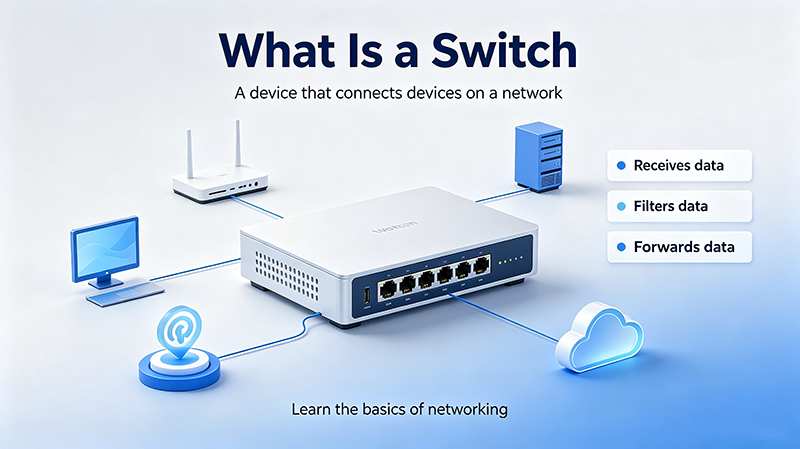
What Is a Switch

In the simplest sense, a switch is a binary device with two states:

  • ON (closed): the contacts touch, allowing current to flow.
  • OFF (open): the contacts separate, breaking the circuit.

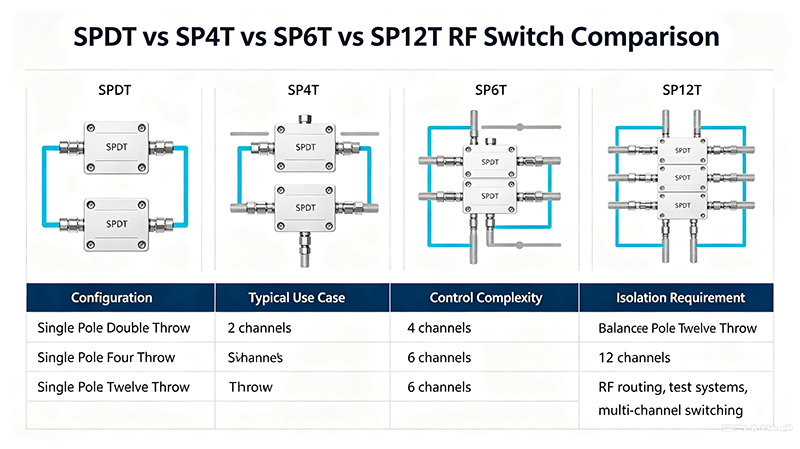
Switches are characterized by their poles (independent circuits they control) and throws (positions each pole can connect to). A common "single-pole double-throw" (SPDT) switch routes a signal between two outputs.

How a Switch Works

Basic Switch Circuit

Source Contact (closed) Load Return

In the closed position, the switch contacts touch and current flows from source to load. In the open position, the contacts separate and the circuit is broken.

When the switch is closed, electrons flow through the contacts with very low resistance (milliohms). When open, an air gap blocks current flow, producing a near-infinite resistance. High-quality switches minimize contact resistance, arcing, and mechanical wear to ensure long life.

Key Switch Specifications

Specification Meaning
Poles / Throws Number of independent circuits and positions
Contact Rating Maximum voltage and current the switch can handle
Contact Resistance Resistance across closed contacts (typ. < 50 mΩ)
Insulation Resistance Resistance across open contacts (typ. > 100 MΩ)
Actuation Force Force required to operate the switch
Travel Distance the actuator moves
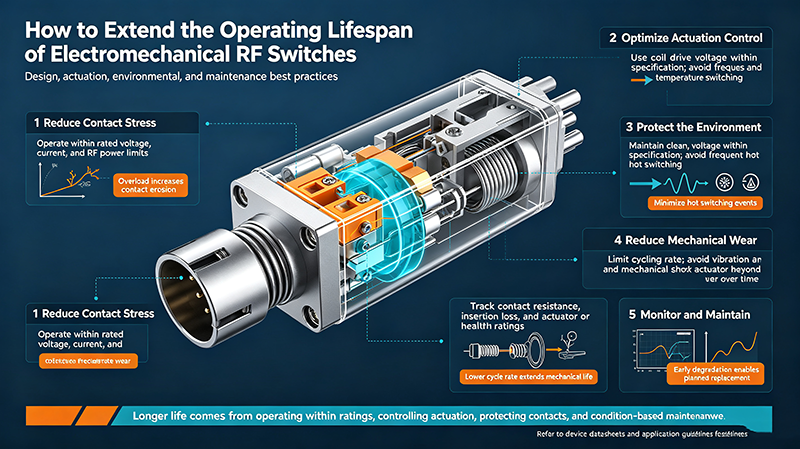
Mechanical Life Number of operations before failure
Electrical Life Operations under load before contact wear
Termination Style Through-hole, SMT, solder lug, screw, quick-connect

Common Types of Switches

Mechanical Switches

Basic

Toggle Switch

Classic bat-style lever for panel mounting. Common in power supplies, instruments, and industrial equipment. Available in SPDT, DPDT, and many other configurations.

Basic

Push-Button Switch

Momentary or latching action. Found in keyboards, doorbells, reset buttons, and consumer electronics. Tactile variants give audible or haptic feedback.

Basic

Slide Switch

Small slider that moves between positions. Common in DIP packages, mode selectors, and hobby electronics.

Basic

Rotary Switch

Spins a shaft to select one of several positions. Used for range selection on multimeters, fan-speed controls, and channel selectors on radios.

Sensor

Limit Switch

Actuated by physical contact with a moving part. Industrial mainstay for detecting end-of-travel on doors, conveyors, and CNC machines.

Sensor

Reed Switch

Two ferromagnetic blades sealed in a glass capsule that close when a magnet approaches. Used in door sensors, bicycle speedometers, and fluid level meters.

Sensor

Microswitch (Snap-Action)

Precision switch with a small actuation distance and crisp snap-action. Standard in appliances, safety interlocks, and vending machines.

Electronics

DIP Switch

A row of tiny slide switches in a DIP package. Used to set hardware options on PCBs, such as device addresses or operating modes.

Electronic & Solid-State Switches

Electronic

Transistor Switch

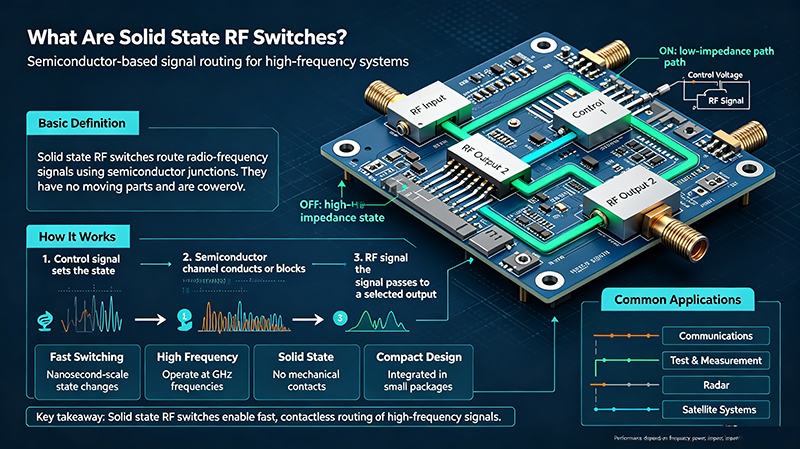
A BJT or MOSFET driven into saturation acts as an electronic switch. No moving parts, fast switching, ideal for microcontrollers driving LEDs or relays.

Electronic

Relay

An electromechanical switch where a coil magnetically closes the contacts. Isolates high-power circuits from low-power control signals.

Electronic

Solid-State Relay (SSR)

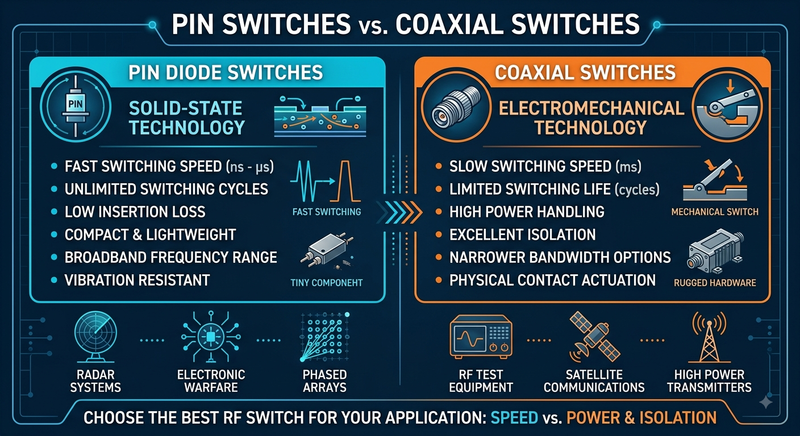
Uses a TRIAC, MOSFET, or thyristor instead of mechanical contacts. No moving parts, silent operation, long life, but some on-state voltage drop.

Electronic

Opto-Isolated Switch

An LED and phototransistor pair that switches optically. Provides thousands of volts of galvanic isolation between input and output.

Special-Purpose Switches

Industrial

Key Switch

Operated only with a matching key. Used for secure power panels and ignition systems.

Industrial

Selector Switch

Panel-mounted switch with maintained positions (e.g., HAND / OFF / AUTO) for industrial control panels.

Sensor

Proximity Switch

Detects objects without physical contact using inductive, capacitive, or magnetic sensing. Common in factory automation.

Sensor

Pressure Switch

Actuates when a fluid or gas pressure crosses a threshold. Used in pumps, HVAC, and hydraulic systems.

Poles and Throws Explained

Code Name Function
SPST Single-Pole Single-Throw Simple ON/OFF switch
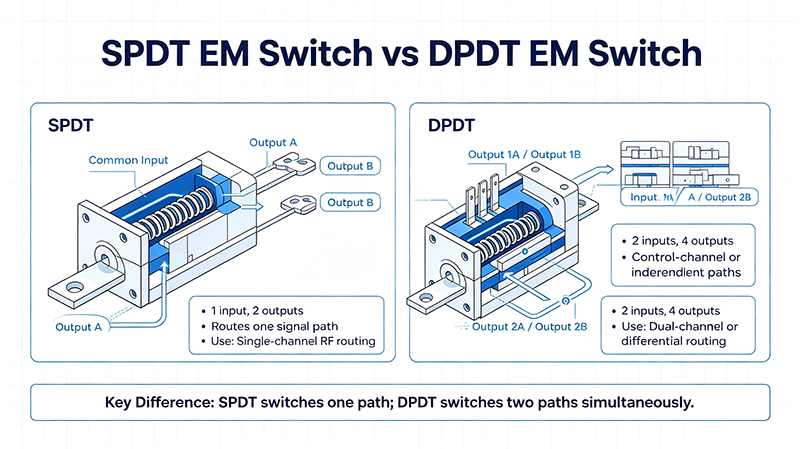
SPDT Single-Pole Double-Throw Routes one input to two outputs
DPST Double-Pole Single-Throw Switches two circuits simultaneously
DPDT Double-Pole Double-Throw Switches two circuits between two outputs each
3PST / 4PDT Triple / Quadruple Special configurations for complex control

Momentary vs. Maintained Action

  • Momentary: the switch returns to its default position when released — used for doorbells, keyboard keys, and reset buttons.
  • Maintained (latching): the switch stays in the new position until actuated again — used for light switches and power toggles.

How to Choose the Right Switch

  1. Define the load: what voltage and current will flow through the contacts?
  2. Determine the environment: indoor, outdoor, wet, dusty, or hazardous locations may require IP-rated or sealed switches.
  3. Pick the actuation style: toggle, push, slide, rotary, or sensor-driven.
  4. Match the circuit topology: SPST, SPDT, DPDT, etc.
  5. Verify mechanical life: a switch pressed once a day needs fewer cycles than one cycled every second.
  6. Choose the mounting style: panel-mount, PCB through-hole, SMT, or wire-lead.
  7. Check electrical ratings: always include a safety margin — never run a switch at 100 % of its rated load continuously.
Safety Tip: Always derate switches by 25 – 50 %. A switch rated for 10 A should ideally switch no more than 5 – 7 A in continuous service. This prevents contact welding, overheating, and premature failure.

Common Switch Applications

  • Consumer electronics: power buttons, mode selectors, keyboard keys, mouse clicks.
  • Home & lighting: wall switches, dimmers, motion sensors.
  • Automotive: ignition, window controls, brake-light switches.
  • Industrial control: limit switches, selector switches, emergency-stop (E-stop) mushrooms.
  • Test & measurement: range selectors, function switches on multimeters.
  • Security: door and window reed switches, tamper sensors.
  • Medical: foot pedals, isolation switches, patient-call buttons.

Switch Wiring Basics

  • Line (L): the incoming hot conductor from the power source.
  • Load: the conductor going to the device being controlled.
  • Neutral (N): completes the circuit back to the source.
  • Ground (PE): protective earth for safety, never switched.

Always switch the line (hot) conductor, never the neutral. Switching neutral can leave dangerous voltage present on the load even when the switch is OFF.

Common Mistakes

  • Exceeding contact rating: causes arcing, welding, and fire hazard.
  • Switching DC instead of AC (or vice versa): DC arcs are harder to extinguish than AC; derate DC switches accordingly.
  • Using the wrong enclosure: an indoor switch in a wet location will fail quickly.
  • Ignoring inrush current: motors and incandescent lamps draw 5 – 10× their rated current at turn-on.
  • Forgetting debounce in software: mechanical switches bounce for several milliseconds — microcontrollers need debouncing code or hardware.

Key Takeaways

  • A switch is a binary component that opens or closes a circuit.
  • Mechanical switches include toggle, push-button, slide, rotary, limit, reed, microswitch, and DIP.
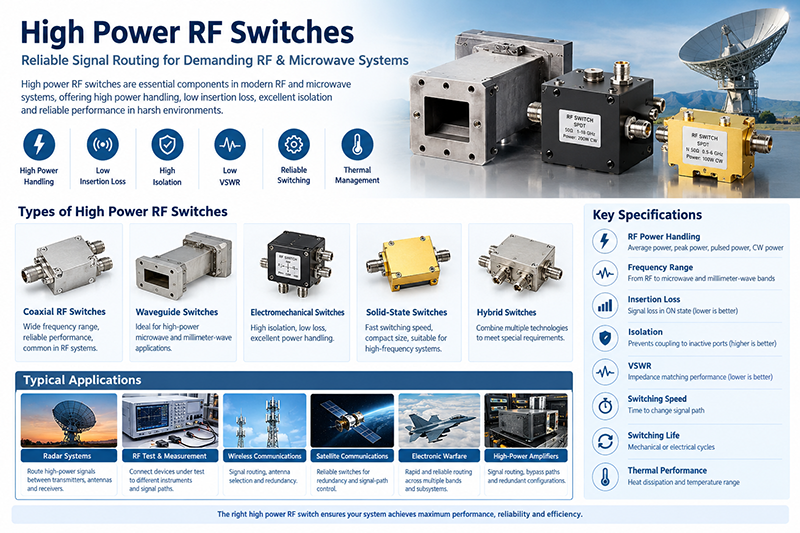
  • Electronic switches include transistors, relays, solid-state relays, and opto-isolators.
  • Poles and throws define how many circuits and positions a switch has.
  • Choose switches based on voltage, current, environment, mounting style, and required cycle life.

Frequently Asked Questions

What is the simplest type of switch?

The single-pole single-throw (SPST) switch is the simplest. It has one input terminal and one output terminal; flipping it opens or closes a single circuit.

What is the difference between momentary and maintained switches?

Momentary switches return to their default state when released (doorbell). Maintained (latching) switches hold their position until actuated again (light switch).

What does "pole" mean on a switch?

A pole is an independent circuit that the switch can control. A switch with two poles (DPDT) can switch two separate circuits simultaneously with one actuator.

Can I use an AC switch for DC?

Generally no. DC creates a sustained arc when contacts open. AC switches are usually derated by 5 – 10× when switching DC. Choose a DC-rated switch for DC loads.

How long do switches last?

Mechanical life ranges from 1,000 cycles for small tactile switches to 100,000+ for industrial toggle switches. Solid-state switches can last millions of cycles because they have no moving parts.

About the Author — MeiXun Team

Wang

Chief Engineer Wang

High-tech Enterprise, Feifeng Talent

Chief Engineer Wang graduated with a master's degree in high-power microwave from the Institute of Electronics, University of Chinese Academy of Sciences.

View Full Profile
Wang

Chief Engineer Wang

High-tech Enterprise, Feifeng Talent

Chief Engineer Wang graduated with a master's degree in high-power microwave from the Institute of Electronics, University of Chinese Academy of Sciences.

In the same year, he joined CETC 40/41 for work and study. He has been committed to the design and development of microwave switches for a long time.

He has applied for 27 patents as the first inventor in the microwave switch field, with 6 authorized invention patents and 14 utility model patents.

The products he developed cover various application platforms such as civilian testing, vehicle-mounted, shipborne, airborne, and missile-borne.

RF Microwave Switch RF Switch Coaxial Switch PIN Diode Switch Low Noise Amplifier Waveguide Switch PIN Switch Microwave Switch