






dBm to Watt Calculator
RF Power Converter
What is dBm?
dBm (decibel-milliwatts) is a logarithmic unit that expresses an electrical power level relative to 1 milliwatt (1 mW). It is widely used in radio frequency (RF), microwave, telecommunications, and audio applications because it can describe both very small and very large power levels in a short, easy-to-read number.
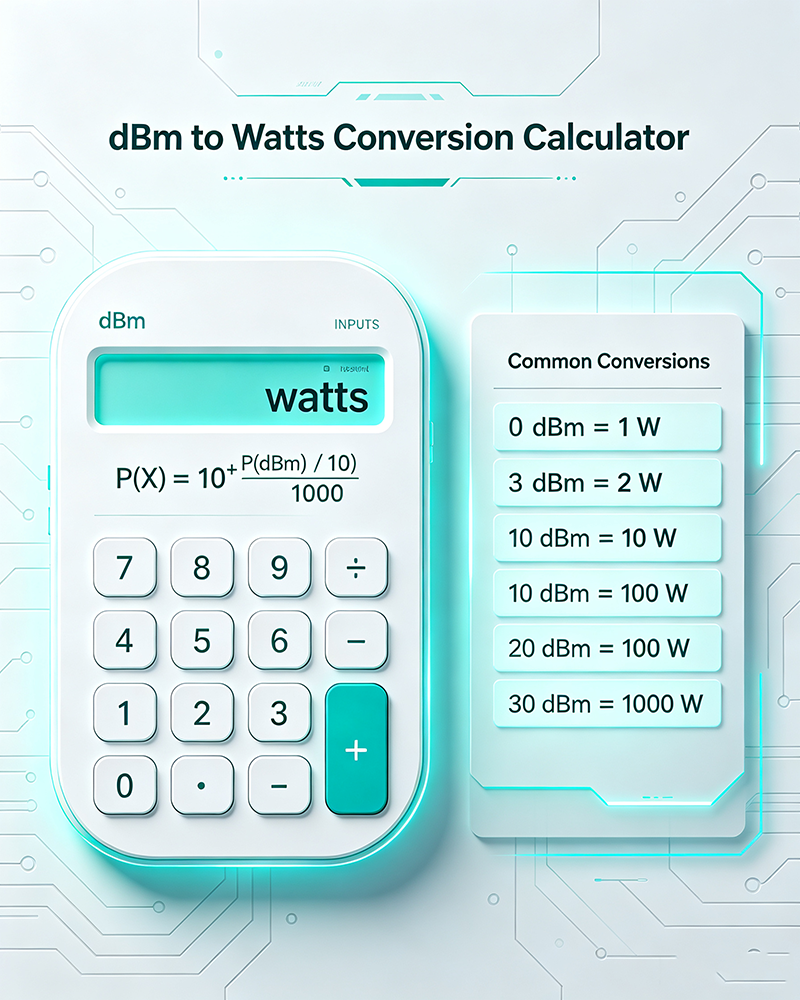
Because dBm is referenced to 1 mW, the relationship between dBm and watts is fixed: 0 dBm = 1 mW and 30 dBm = 1 W. Every increase of 10 dB represents a tenfold increase in linear power, and every +3 dB step roughly doubles the power.
dBm to Watts Conversion Formula
To convert from dBm to watts, use the standard logarithmic formula:
Equivalently, to convert directly to milliwatts (mW):
Watts to dBm Formula
To convert in the reverse direction, from watts back to dBm:
Worked Example: 30 dBm to Watts
Let's convert 30 dBm into watts using the formula above:
- Apply the formula: P(W) = 1 × 10 ^ ( (30 − 30) / 10 )
- Simplify the exponent: (30 − 30) / 10 = 0
- Compute: 10 ^ 0 = 1
Result: 30 dBm = 1 W. That is exactly why the dBm scale is so convenient for RF work — a nice round number such as 30 dBm represents exactly one watt.
Example: 50 dBm to Watts
- P(W) = 1 × 10 ^ ( (50 − 30) / 10 ) = 1 × 10 ^ 2
- P(W) = 100 W
So 50 dBm = 100 watts. This is typical of high-power broadcast transmitters.
Example: 20 dBm to Watts
- P(W) = 1 × 10 ^ ( (20 − 30) / 10 ) = 1 × 10 ^ −1
- P(W) = 0.1 W
So 20 dBm = 0.1 W = 100 mW, a common output power for Wi-Fi routers and small RF modules.
dBm to Watts Conversion Table
| Power (dBm) | Power (W) | Power (mW) | Typical Application |
|---|---|---|---|
| −30 dBm | 0.000001 W | 0.001 mW | Very small received signal |
| −20 dBm | 0.00001 W | 0.01 mW | Low-level RF reception |
| −10 dBm | 0.0001 W | 0.1 mW | Below 1 mW reference |
| 0 dBm | 0.001 W | 1 mW | dBm reference point |
| 10 dBm | 0.01 W | 10 mW | Low-power transmitter |
| 20 dBm | 0.1 W | 100 mW | Wi-Fi / Bluetooth typical |
| 30 dBm | 1 W | 1,000 mW | 1 W reference |
| 40 dBm | 10 W | 10,000 mW | High-power RF |
| 50 dBm | 100 W | 100,000 mW | Broadcast transmitter |
Rules of Thumb for dBm
These mental shortcuts let you estimate power conversions in your head. For example, moving from 30 dBm (1 W) up to 40 dBm adds 10 dB, multiplying the power by 10, giving 10 W. Going the other way, 30 dBm → 27 dBm is −3 dB, so the power becomes 0.5 W.
Common Use Cases
- Wi-Fi & Cellular Networks: Translate RSSI, transmit power, and link-budget values between dBm and mW during site surveys.
- Ham Radio & SDR: Stay within legal transmit limits expressed in watts while reading specifications in dBm.
- Antenna Design: Convert EIRP, gain, and cable-loss figures between logarithmic (dB, dBi, dBm) and linear (W) units.
- Lab & Test Equipment: Compare power-meter readings from devices that report in dBm vs. watt-meters.
- Audio Engineering: Some pro-audio gear expresses output level in dBm referenced to 600 Ω.
Difference Between dB, dBm, dBW and dBi
Although they look similar, these units describe very different things:
- dB — a relative ratio between two power values (gain or loss). It is unitless.
-
dBm — absolute power referenced to
1 mW. -
dBW — absolute power referenced to
1 W. dBW = dBm − 30. - dBi — antenna gain expressed in dB relative to an isotropic radiator.
You cannot directly convert dB to dBm without knowing the original reference power, because dB on its own carries no absolute information.
How to Use This Calculator
- Select the conversion direction: dBm → Watts or Watts → dBm.
- Enter the value you want to convert (negative values are supported for very small powers).
- Read the result instantly in watts, milliwatts, microwatts, and dBW.
Frequently Asked Questions
What is 0 dBm in watts?
0 dBm equals exactly 1 milliwatt (0.001 W). This is the reference point of the dBm scale, since dBm is defined relative to 1 mW.
How many watts is 30 dBm?
30 dBm equals 1 watt. Every +10 dB step multiplies power by 10, so 30 dB above 1 mW gives 1,000 mW = 1 W.
What is the difference between dBm and dBW?
Both are absolute logarithmic power units, but they use different references. dBm is referenced to 1 mW, while dBW is referenced to 1 W. To convert: dBW = dBm − 30, and dBm = dBW + 30.
Can you convert dB to dBm?
Not directly. dB expresses a ratio between two values, while dBm is an absolute unit. To get dBm you must first know the reference power in mW or W.
Where is dBm used?
dBm is standard in RF and microwave engineering, Wi-Fi signal strength, cellular network planning, satellite links, spectrum analysis, and laboratory test equipment.
About the Author — MeiXun Team
Chief Engineer Wang
High-tech Enterprise, Feifeng Talent
Chief Engineer Wang graduated with a master's degree in high-power microwave from the Institute of Electronics, University of Chinese Academy of Sciences.
View Full Profile- RF Switch Circuit Diagram
- RF Switch
- Ohm's Law
- dBm to Watt
- mW to dBm
- Wavelength to Frequency
- RF Connector
- SMA Connector
- RF Switch Module
- RF Coupler
- RF PIN Switch
- Microwave Coaxial Switch
- PIN Switch
- Coaxial RF Switch
- Waveguide Switch
- Microwave Switch
- Low Noise Amplifier
- PIN Diode Switch
- Coaxial Switch
- RF Microwave Switch
- SPST Switch