











Ohm's Law
Ohm's Law Calculator
Enter any two values; the other two are calculated automatically.
The Formula
With Joule's Law of heating, electrical power is calculated as:
Who Discovered Ohm's Law?
Georg Simon Ohm (1789 – 1854), a German physicist and mathematician, published the law in 1827 in his book Die galvanische Kette, mathematisch bearbeitet (The Galvanic Circuit Investigated Mathematically). Despite initial skepticism, his work became the foundation of circuit analysis.
The unit of resistance — the ohm (Ω) — is named in his honor.
Formula Wheel
| To Find | Using V & I | Using R | Using P |
|---|---|---|---|
| Voltage (V) | — | V = I × R | V = P / I |
| Current (I) | — | I = V / R | I = P / V |
| Resistance (R) | R = V / I | — | R = V² / P |
| Power (P) | P = V × I | P = I² × R | — |
What Is Ohm's Law?
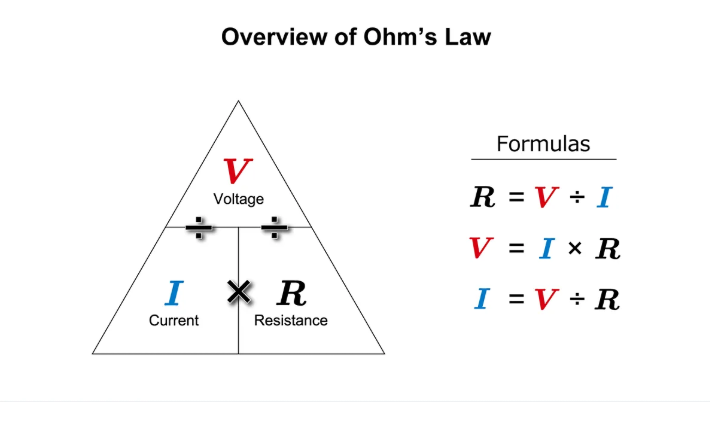
Ohm's Law states that the current flowing through a conductor between two points is directly proportional to the voltage across those two points, and inversely proportional to the resistance. The constant of proportionality is the resistance R:
V = I × R
The law applies to ohmic conductors — materials whose resistance stays constant over the operating range. Metals at constant temperature are ohmic; diodes, transistors, and other semiconductors are non-ohmic.
Understanding V, I, and R
- Voltage (V): the electrical potential difference between two points, measured in volts. Think of it as the "pressure" pushing electrons through a circuit.
- Current (I): the flow of electric charge, measured in amperes. The amount of charge passing a point per second.
- Resistance (R): the opposition to current flow, measured in ohms. A higher resistance means less current for the same voltage.
Quick Example
A 12 V battery is connected to a 4 Ω resistor. What is the current?
Power dissipated by the resistor:
Common Examples
| Circuit | Voltage | Current | Resistance | Power |
|---|---|---|---|---|
| LED bulb | 120 V | 0.083 A | 1,440 Ω | 10 W |
| Space heater | 120 V | 12.5 A | 9.6 Ω | 1,500 W |
| 20A kitchen circuit | 120 V | 20 A | 6 Ω | 2,400 W |
| EV charger | 240 V | 30 A | 8 Ω | 7,200 W |
Real-World Applications
1. Circuit Design
Engineers use Ohm's Law to choose resistor values, calculate voltage drops, and verify current limits in analog and digital circuits.
2. Power Supplies
Power supply sizing relies on P = V × I to choose transformers, fuses, and wire gauges.
3. Battery and Solar Design
Battery capacity, solar panel output, and load matching all use Ohm's Law and power formulas.
4. Electrical Wiring
Electricians calculate branch-circuit current to size wiring and overcurrent protection per electrical codes.
5. Electronics Troubleshooting
Technicians use Ohm's Law to predict expected voltages and currents, then compare with measurements.
6. Heating and Lighting
Heater and lamp design uses P = V² / R to choose resistance values for desired power dissipation.
Limitations
- Non-ohmic devices: diodes, transistors, and incandescent bulbs change resistance with operating point or temperature.
- AC reactive circuits: for AC with capacitors or inductors, use impedance Z = √(R² + X²) instead of R alone.
- Non-linear media: arcs, plasma, and semiconductors deviate significantly.
Common Mistakes
- Mixing up units: voltage in mV, current in mA, and resistance in kΩ gives wrong results without conversion.
- Confusing power formulas: use P = I² × R only with the current through R, not the source current.
- Forgetting load resistance changes with temperature: filaments and thermistors are non-linear.
- Applying to AC reactive circuits: must use impedance, not just resistance.
Frequently Asked Questions
What is Ohm's Law formula?
V = I × R. Voltage equals current times resistance. Rearranged: I = V / R and R = V / I.
Does Ohm's Law apply to AC circuits?
Only for purely resistive loads. AC circuits with inductors or capacitors require impedance (Z) instead of resistance.
Who discovered Ohm's Law?
Georg Ohm, a German physicist, published it in 1827.
How do I calculate power with Ohm's Law?
P = V × I, also P = I² × R, and P = V² / R. All three are equivalent.
What is the unit of resistance?
The ohm (Ω). One ohm lets one ampere flow under one volt.
About the Author — MeiXun Team
Chief Engineer Wang
High-tech Enterprise, Feifeng Talent
Chief Engineer Wang graduated with a master's degree in high-power microwave from the Institute of Electronics, University of Chinese Academy of Sciences.
View Full Profile- RF Switch Circuit Diagram
- RF Switch
- Ohm's Law
- dBm to Watt
- mW to dBm
- Wavelength to Frequency
- RF Connector
- SMA Connector
- RF Switch Module
- RF Coupler
- RF PIN Switch
- Microwave Coaxial Switch
- PIN Switch
- Coaxial RF Switch
- Waveguide Switch
- Microwave Switch
- Low Noise Amplifier
- PIN Diode Switch
- Coaxial Switch
- RF Microwave Switch
- SPST Switch