






mW to dBm Conversion Calculator
RF Power Converter
Formula Used
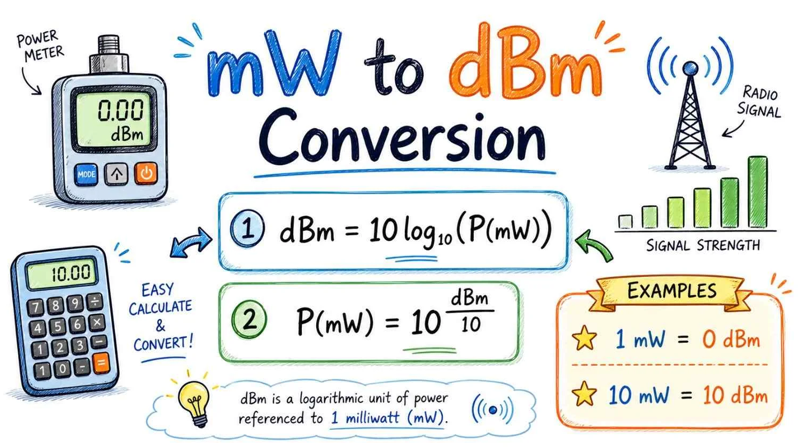
The calculator uses these standard power-conversion formulas:
Adjusted dBm adds gain and subtracts loss:
How to Use
- Enter the power value in mW or dBm.
- Select the conversion direction.
- Optionally, add amplifier gain or cable loss in dB to compute the adjusted value.
- The result instantly appears in mW, dBm, adjusted dBm, Watts, and dBW.
mW to dBm Quick Reference Table
| Power (mW) | dBm | dBW | Typical Use |
|---|---|---|---|
| 0.001 | −30 | −60 | Very small received signal |
| 0.01 | −20 | −50 | Weak measured power |
| 0.1 | −10 | −40 | Small RF signal |
| 1 | 0 | −30 | Reference level (0 dBm) |
| 10 | 10 | −20 | Moderate device output |
| 100 | 20 | −10 | Higher transmitter output |
| 1000 | 30 | 0 | One watt (1 W) |
| 10000 | 40 | 10 | 10 W transmitter |
Rules of Thumb
Common RF Power Reference
| Device / Standard | Typical Power |
|---|---|
| GPS received signal | −130 dBm / 0.1 fW |
| Bluetooth Class 2 Tx | +4 dBm / 2.5 mW |
| Wi-Fi 802.11n max | +20 dBm / 100 mW |
| LTE/4G mobile max | +23 dBm / 200 mW |
| 2.4 GHz Wi-Fi AP typical | +15 to +20 dBm |
| Microwave oven leakage limit | −22 dBm/cm² |
| FM broadcast transmitter | +67 to +80 dBm / 5–10 kW |
Why Use dBm?
Linear power can be hard to compare across the wide dynamic range of RF systems. One thousand milliwatts is vastly larger than one milliwatt; in dBm, that change becomes a clean +30 dBm. Engineers can add gains and losses directly in decibels instead of multiplying power ratios — making link-budget analysis a matter of simple addition and subtraction.
Best Practices
- Use the same reference across every calculation.
- Keep units consistent — never mix watts and milliwatts without conversion.
- Check whether gain values are positive or negative before adding.
- Round only the final result when reporting; keep raw values for traceability.
- Use measured input power when possible — datasheet values may be ideal.
Frequently Asked Questions
What is 0 dBm in mW?
0 dBm equals exactly 1 milliwatt (1 mW). dBm uses 1 mW as its reference point, so log10(1) = 0.
What is the formula for mW to dBm?
The formula is dBm = 10 × log10(mW). The mW value must be greater than zero.
Can I include cable loss in this calculator?
Yes. Enter cable or connector loss in the Loss field. The calculator subtracts that value from the raw dBm.
Can I include amplifier gain?
Yes. Enter amplifier gain in dB. The calculator adds that value to the raw dBm before showing the adjusted result.
Does impedance change dBm?
No. dBm is referenced to 1 mW. Impedance only affects the RMS voltage and current values for a given power.
About the Author — MeiXun Team
Chief Engineer Wang
High-tech Enterprise, Feifeng Talent
Chief Engineer Wang graduated with a master's degree in high-power microwave from the Institute of Electronics, University of Chinese Academy of Sciences.
View Full Profile- RF Switch Circuit Diagram
- RF Switch
- Ohm's Law
- dBm to Watt
- mW to dBm
- Wavelength to Frequency
- RF Connector
- SMA Connector
- RF Switch Module
- RF Coupler
- RF PIN Switch
- Microwave Coaxial Switch
- PIN Switch
- Coaxial RF Switch
- Waveguide Switch
- Microwave Switch
- Low Noise Amplifier
- PIN Diode Switch
- Coaxial Switch
- RF Microwave Switch
- SPST Switch