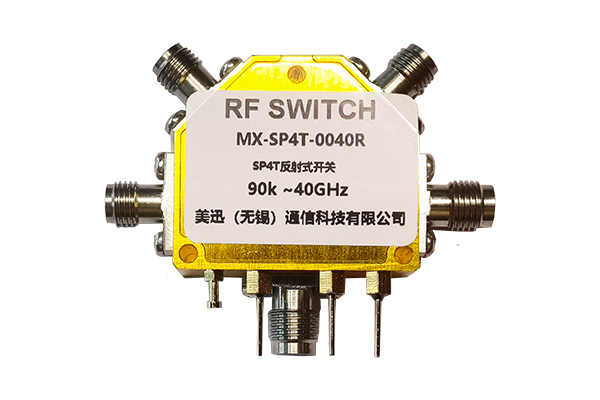
RF switches are essential components in modern wireless communication systems,
test and measurement equipment, radar systems, satellite communication, and
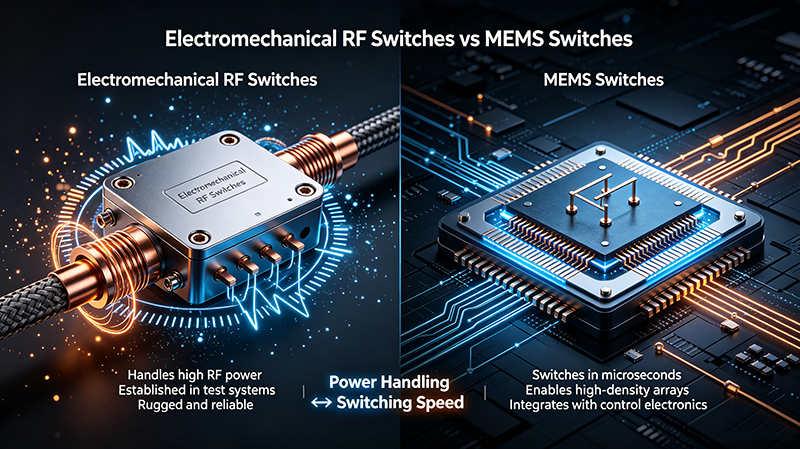
5G infrastructure. Among the available technologies, electromechanical RF switches and MEMS (Micro-Electro-Mechanical Systems) switches are two important
solutions for high-performance RF signal routing.
While electromechanical switches have been widely used for decades due to their
excellent RF performance and reliability, MEMS switches have emerged as a promising
alternative with advantages in size, power consumption, and integration capability.
This article provides a detailed comparison between electromechanical RF switches
and MEMS switches to help engineers select the right technology for their applications.
What Are Electromechanical RF Switches?
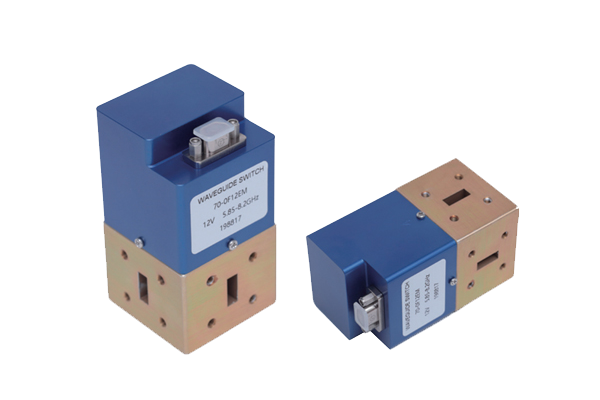
Electromechanical RF switches use physical mechanical movement to control RF signal
paths. A mechanical actuator moves contacts between different positions, allowing
the switch to connect or disconnect electrical circuits.
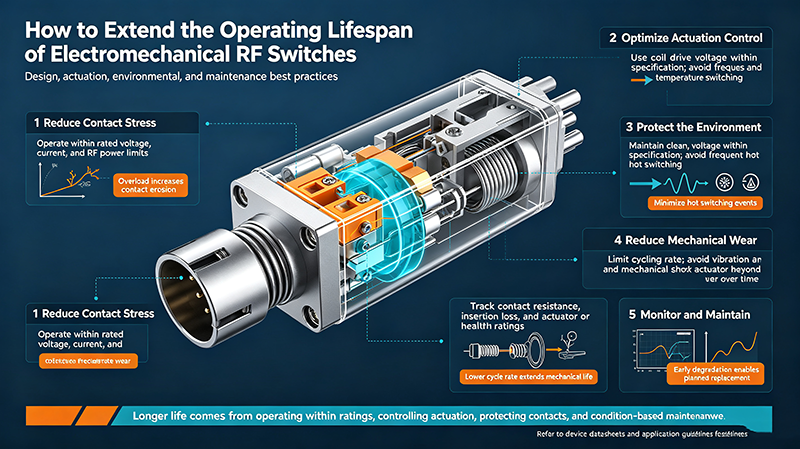
These switches are commonly manufactured using coaxial, waveguide, or relay-based
structures and are widely used in applications requiring excellent isolation,
low insertion loss, and high power handling capability.
Advantages of Electromechanical RF Switches
-
Excellent RF performance: Provides very low insertion loss and high isolation.
-
High power handling: Suitable for transmitters, radar, and high-power test systems.
-
Wide frequency range: Available from DC to millimeter-wave frequencies.
-
High linearity: Maintains signal integrity with minimal distortion.
-
Mature technology: Proven reliability in aerospace, defense, and industrial applications.
Limitations of Electromechanical RF Switches
-
Mechanical movement limits switching speed.
-
Physical size is larger compared with semiconductor-based solutions.
-
Mechanical wear may reduce lifetime after many switching cycles.
-
Requires higher drive power for operation.
What Are MEMS RF Switches?
MEMS RF switches use microscopic mechanical structures fabricated through
semiconductor manufacturing processes. Instead of traditional mechanical contacts,
MEMS switches use tiny movable beams or membranes controlled by electrical signals
to change RF transmission paths.
MEMS technology combines mechanical switching behavior with semiconductor
manufacturing advantages, enabling extremely compact RF components with low power
consumption.
Advantages of MEMS RF Switches
-
Ultra-low power consumption: Requires very little energy compared with traditional relays.
-
Compact size: Ideal for miniaturized RF modules and integrated systems.
-
High isolation: Provides excellent signal separation at high frequencies.
-
Low parasitic effects: Offers excellent performance for microwave and millimeter-wave applications.
-
Fast switching: Faster than many traditional mechanical RF switches.
Limitations of MEMS RF Switches
-
Lower power handling capability compared with electromechanical switches.
-
Environmental sensitivity, including temperature and vibration effects.
-
Manufacturing complexity increases cost for some applications.
-
Long-term reliability remains a key consideration in harsh environments.
Electromechanical RF Switches vs MEMS Switches: Key Performance Comparison
|
Parameter
|
Electromechanical RF Switch
|
MEMS RF Switch
|
|
Switching Speed
|
Milliseconds range
|
Microseconds to milliseconds range
|
|
Insertion Loss
|
Very low, typically excellent performance
|
Very low, especially at high frequencies
|
|
Isolation
|
Excellent isolation performance
|
High isolation with low parasitic effects
|
|
Power Handling
|
High power capability
|
Limited compared with mechanical switches
|
|
Size
|
Larger mechanical structure
|
Extremely compact
|
|
Power Consumption
|
Higher drive power required
|
Very low power consumption
|
|
Lifetime
|
Millions of switching cycles depending on design
|
High cycle capability but application dependent
|
|
Cost
|
Lower due to mature manufacturing
|
Higher due to advanced fabrication process
|
RF Performance Comparison
Insertion Loss
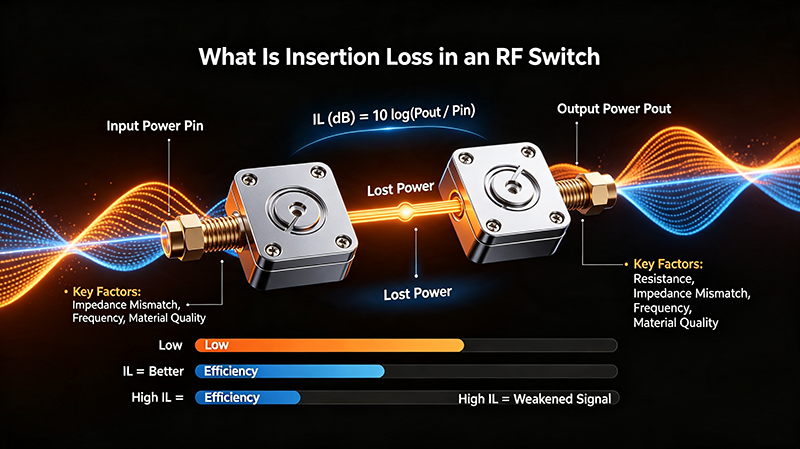
Insertion loss is a critical parameter that determines how much RF signal power is
lost when passing through a switch. Electromechanical RF switches typically provide
extremely low insertion loss because the signal path uses direct metal contacts.
MEMS switches also achieve excellent insertion loss performance, especially at
microwave and millimeter-wave frequencies, because their structures introduce
minimal parasitic capacitance and inductance.
Isolation Performance
Both technologies provide strong isolation between signal channels. Electromechanical
switches generally achieve higher isolation at lower frequencies, while MEMS switches
perform particularly well in high-frequency applications due to reduced parasitic effects.
Switching Speed
MEMS switches typically outperform electromechanical switches in switching speed.
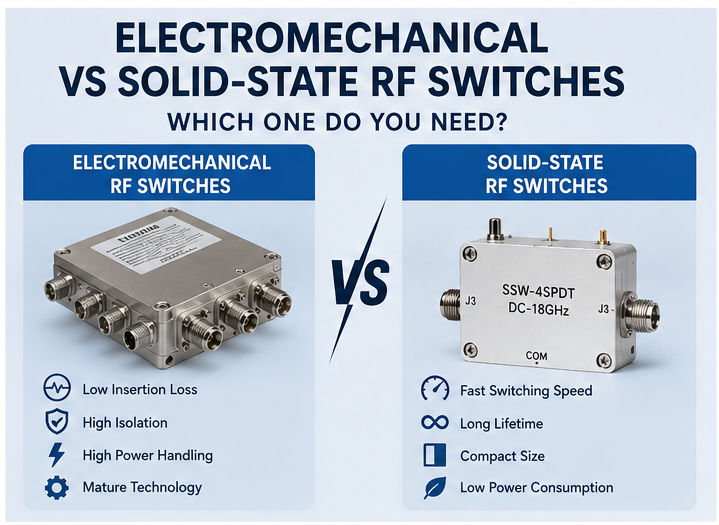
However, both technologies are slower than solid-state RF switches such as PIN diode
and GaAs switches.
Applications of Electromechanical RF Switches
-
RF and microwave test equipment
-
Satellite communication systems
-
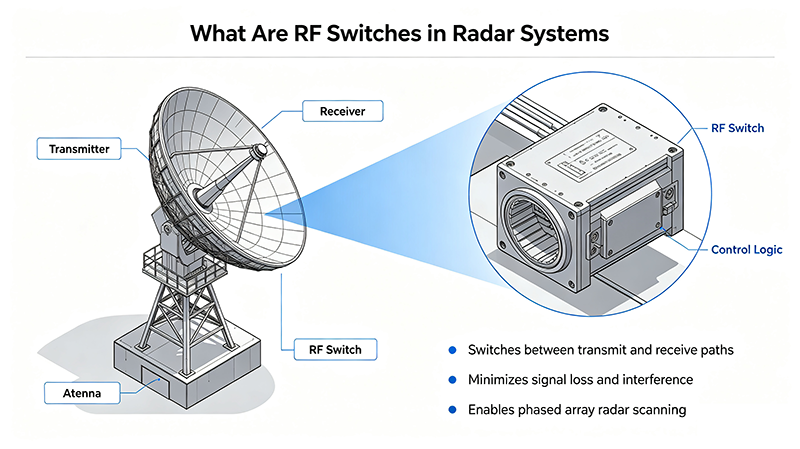
Radar and defense systems
-
High-power RF signal routing
-
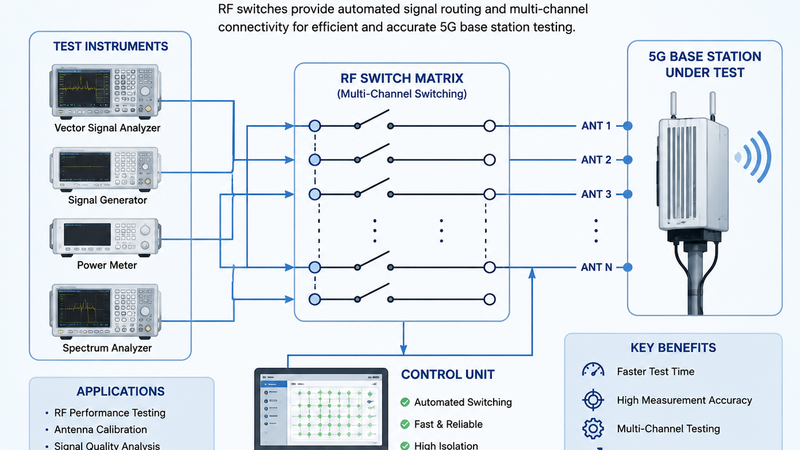
Automated measurement platforms
-
5G base station testing systems
Applications of MEMS RF Switches
-
5G and future wireless communication systems
-
Phased array antennas
-
Compact RF modules
-
Internet of Things (IoT) devices
-
Millimeter-wave communication systems
-
Integrated microwave circuits
How to Choose Between Electromechanical and MEMS RF Switches?
The correct RF switch technology depends on application requirements, including
frequency range, power handling, switching speed, size limitations, and reliability
requirements.
Choose Electromechanical RF Switches When:
-
You need maximum RF performance and isolation.
-
Your system requires high power handling.
-
Long-term proven reliability is essential.
-
The application involves laboratory testing or defense systems.
Choose MEMS RF Switches When:
-
Miniaturization is a priority.
-
Low power consumption is required.
-
The application operates at high microwave or millimeter-wave frequencies.
-
Integration with semiconductor devices is important.
Future Development Trends of RF Switch Technology
The demand for higher-frequency communication systems, including 5G Advanced,
6G networks, and millimeter-wave applications, continues to drive innovation in
RF switching technology.
Electromechanical RF switches will remain important in high-power and precision
measurement applications due to their outstanding RF characteristics. Meanwhile,
MEMS switches are expected to grow rapidly in compact wireless devices and
integrated RF systems.
Conclusion
Electromechanical RF switches and MEMS switches each offer unique advantages.
Electromechanical switches provide superior power handling, reliability, and
mature RF performance, making them ideal for demanding applications such as
aerospace, defense, and RF testing.
MEMS switches offer compact size, low power consumption, and excellent high-frequency
performance, making them attractive for next-generation wireless communication
systems.
Understanding the differences between these two technologies allows engineers to
select the optimal RF switch solution based on performance requirements, system
constraints, and application goals.