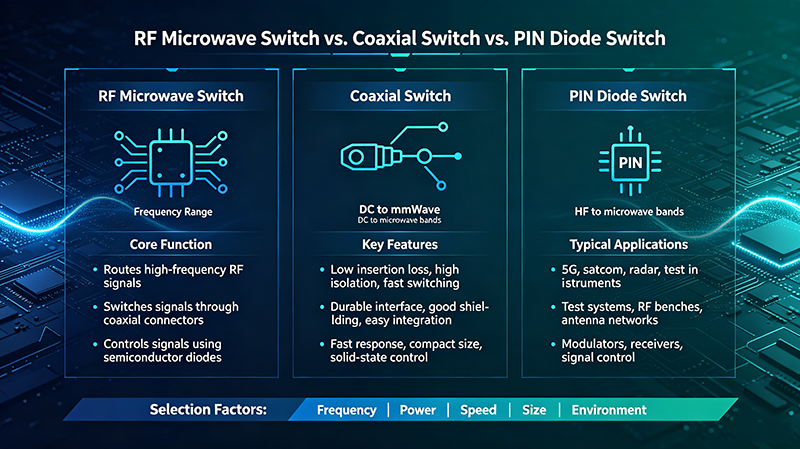
As wireless systems scale into mmWave, 5G/6G, satellite communications, and mission-critical aerospace applications, the choice of switch technology shapes overall RF performance.
PIN diode switches have dominated for decades thanks to their speed and power handling.
RF MEMS switches promise near-ideal linearity and ultra-low loss. This guide compares both technologies head-to-head — and answers which one truly dominates the next generation of RF systems.
1. Why This Comparison Matters
RF switches sit at the front of every high-frequency signal chain. A wrong technology choice can:
-
Erode link budget by adding 1–2 dB of unnecessary loss.
-
Limit system linearity and generate intermodulation distortion.
-
Shorten product lifetime in high-cycle or hot-switching applications.
-
Inflate BOM cost or board area.
Choosing between PIN diode and MEMS switches is therefore a strategic decision — not just a component selection.
2. How PIN Diode Switches Work
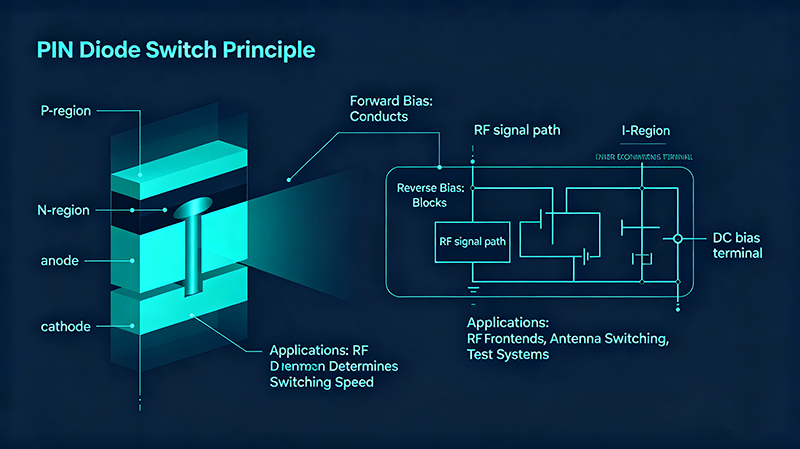
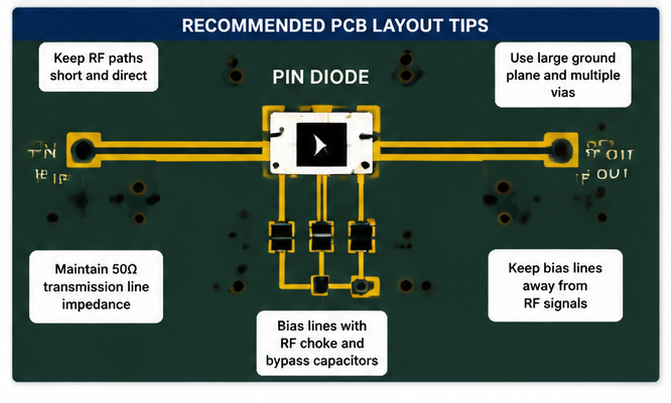
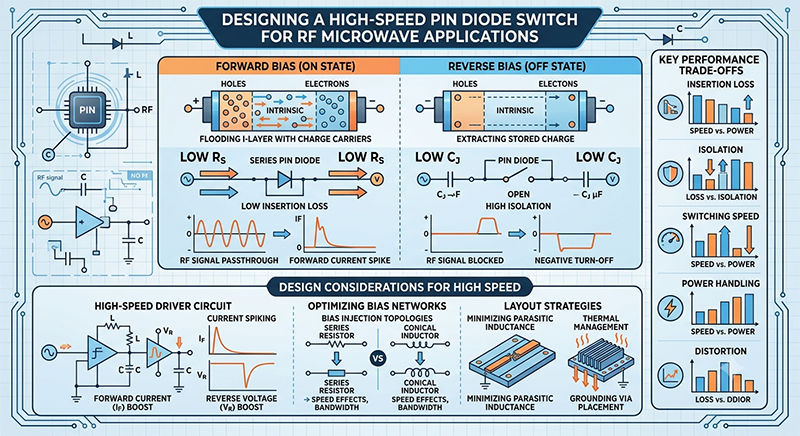
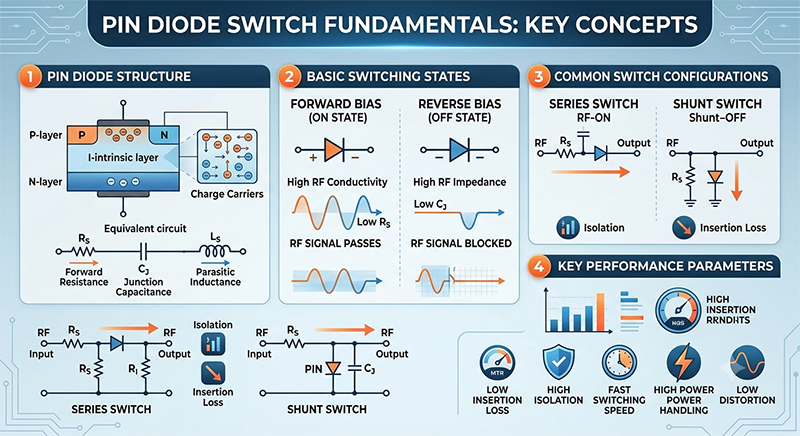
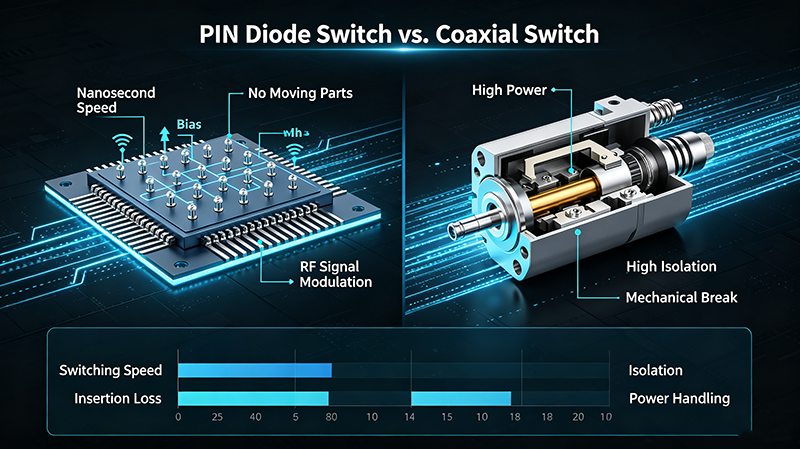
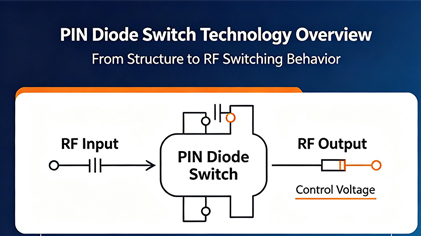
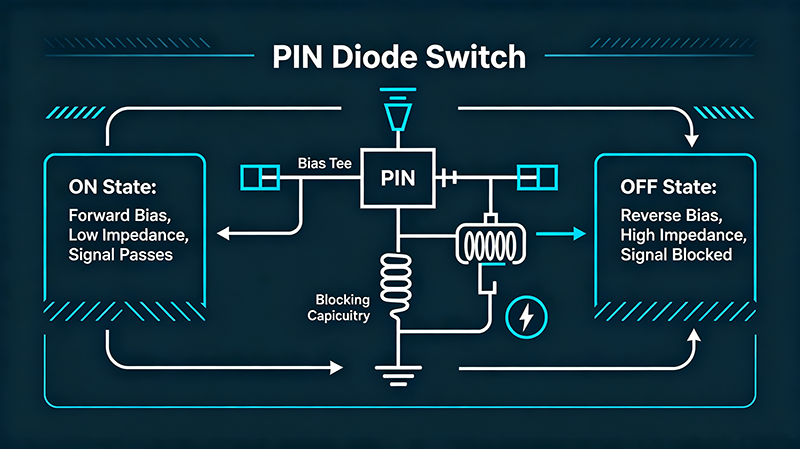
A PIN diode is a semiconductor device with an intrinsic (I) region sandwiched between P and N regions. When forward-biased, charge carriers flood the I region, making the diode behave like a low-resistance RF conductor. When reverse-biased or unbiased, the I region acts as a low-capacitance insulator, blocking RF.
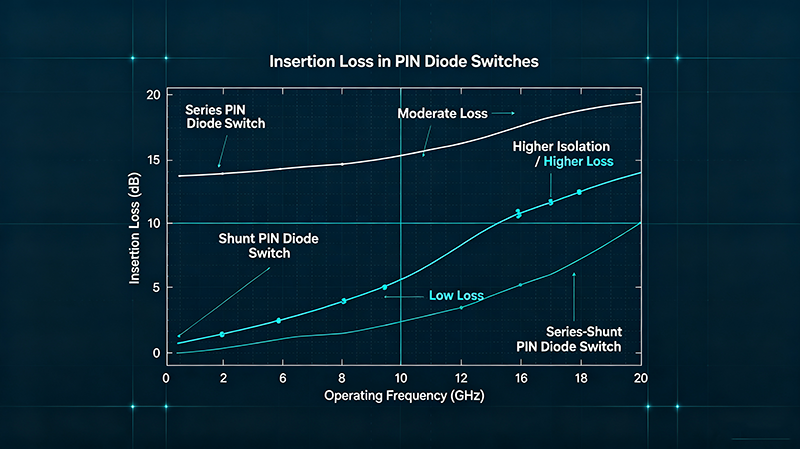
By arranging multiple PIN diodes in series-shunt configurations, designers build SPDT, DPDT, SPnT, and matrix switches. PIN switches require a small DC bias current (typically 5–50 mA) to maintain the ON state.
Key traits: fast switching (10–100 ns), high power handling, broadband, mature supply chain.
3. How MEMS Switches Work
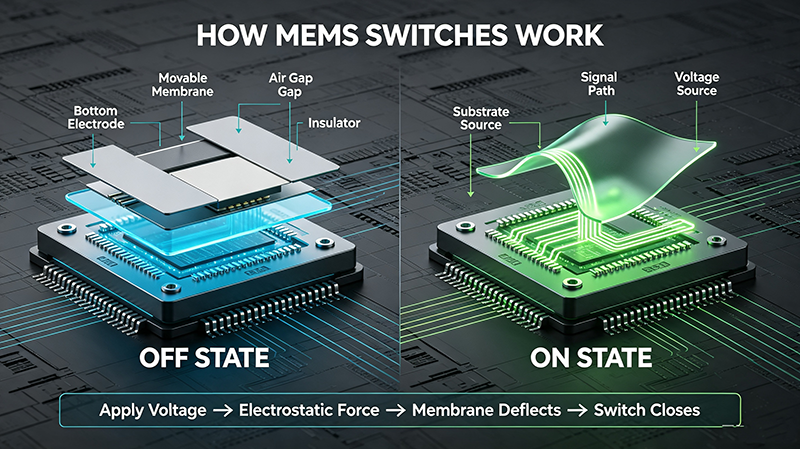
An RF MEMS switch uses a microscopic mechanical beam or cantilever that physically moves to make or break an RF contact. Actuation is electrostatic, thermal, or piezoelectric. Because the signal path contains no semiconductor junction in the ON state, MEMS switches approach the linearity and loss of an ideal mechanical relay — at a fraction of the size.
Key traits: near-zero power consumption, ultra-low loss (0.1–0.3 dB), excellent linearity (IP3 > +65 dBm), but slower switching (µs to ms).
4. Head-to-Head Specification Comparison
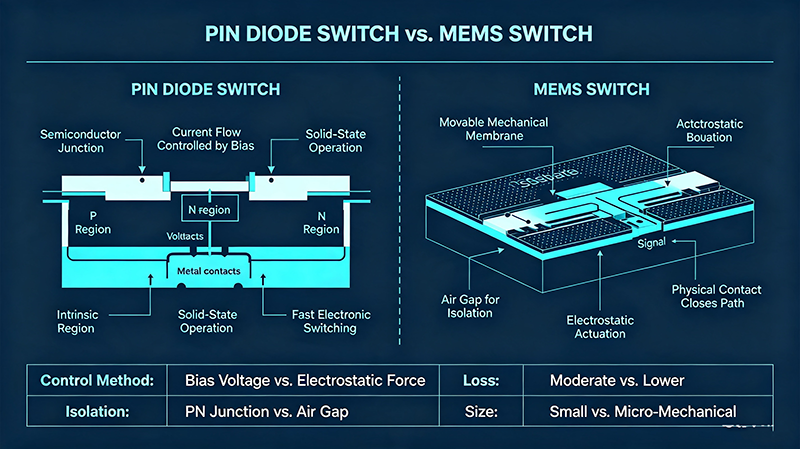
|
Parameter
|
PIN Diode Switch
|
RF MEMS Switch
|
|
Insertion Loss (6 GHz)
|
0.3–0.8 dB
|
0.1–0.3 dB
|
|
Insertion Loss (40 GHz)
|
1.0–1.5 dB
|
0.4–0.7 dB
|
|
Isolation (6 GHz)
|
40–55 dB
|
30–50 dB
|
|
Switching Speed
|
10–100 ns
|
5–300 µs
|
|
Power Handling (CW)
|
10 W and above
|
0.5–2 W typical
|
|
IP3 (Linearity)
|
+40–+55 dBm
|
+65–+80 dBm
|
|
DC Bias Current
|
5–50 mA
|
Near zero
|
|
Cycle Life
|
> 1 billion (cold switching)
|
100M–1B (improving)
|
|
Hot-Switch Capable
|
Yes (limited)
|
Limited (contact wear)
|
|
Operating Temp
|
−55 °C to +125 °C
|
−40 °C to +85 °C
|
|
Cost (relative)
|
Low
|
High
|
|
Supply Maturity
|
Mature, multi-source
|
Limited suppliers
|
Quick Take: PIN diode wins on speed, power, and cost. MEMS wins on loss, linearity, and quiescent power.
5. Strengths & Weaknesses
PIN Diode
Strengths
-
Nanosecond switching speed
-
High RF power handling
-
Broadband DC to 18+ GHz
-
Mature, low-cost supply chain
-
Tolerates hot-switching (with design care)
-
Wide operating temperature range
Weaknesses
-
Higher insertion loss than MEMS
-
Requires continuous DC bias
-
Generates harmonics and IMD
-
Lower IP3 limits high-linearity use
MEMS
Strengths
-
Ultra-low insertion loss
-
Near-ideal linearity (IP3 > +65 dBm)
-
Zero quiescent power
-
Excellent linearity over temperature
-
Broadband performance
-
Compact, hermetically packaged
Weaknesses
-
Slower switching (µs range)
-
Limited hot-switch power
-
Higher unit cost
-
Fewer qualified suppliers
-
Contact reliability still maturing
-
Limited high-temp operation
6. Application Fit
6.1 Where PIN Diodes Dominate
-
5G sub-6 GHz T/R switching — needs speed and power at low cost.
-
Radar pulse routing — high peak power and fast switching.
-
Antenna tuning & band selection — mobile handsets and base stations.
-
Test & measurement instruments — broadband power monitoring.
-
Defence ECM / EW systems — high reliability under stress.
6.2 Where MEMS Dominate
-
Satellite payload switching — ultra-low loss preserves EIRP and G/T.
-
mmWave test stands — loss matters more than speed.
-
Aerospace telemetry — ultra-linear signal routing.
-
Low-power IoT front-ends — zero quiescent current.
-
Phased-array calibration — high linearity preserves beam purity.
7. Which Technology Dominates Future RF?
Looking at the trajectory of wireless systems, three forces are shaping switch technology choices:
-
mmWave and 6G proliferation — as frequency climbs to 28, 39, and 140 GHz, every 0.1 dB of switch loss matters more. This favors MEMS and GaAs over lossy PIN diodes.
-
Satellite mega-constellations — thousands of low-cost satellites demand switches that are both low loss and affordable. This drives hybrid approaches and MEMS scale-up.
-
AI-defined radio front-ends — cognitive radios and reconfigurable antennas need high-linearity, low-loss switches that don't distort wideband signals. MEMS excels here.
-
Cost pressure in consumer 5G — handsets will continue to use PIN diodes and SOI switches for cost reasons; MEMS remains a premium option.
Industry Forecast: PIN diode volumes will keep growing thanks to mobile, IoT, and defence. MEMS adoption will accelerate in satellite, instrumentation, and high-end mmWave — but PIN will remain the volume leader through at least 2030.
8. Final Verdict
Choose PIN Diode if…
You need high speed, high RF power, hot-switching capability, and a mature supply chain at the lowest cost. Ideal for 5G handsets, base stations, radar, and defence systems.
Choose MEMS if…
You need ultra-low insertion loss, exceptional linearity, near-zero DC power, and your application tolerates slower switching and higher cost. Ideal for satellite payloads, mmWave test, and aerospace.
9. Frequently Asked Questions
Q1: Are MEMS switches reliable enough for production?
Yes — modern RF MEMS from leading suppliers deliver 100M–1B cycles under proper bias and hermetic packaging. They are deployed in production satellite and instrumentation systems.
Q2: Why are PIN diodes still cheaper?
PIN diodes benefit from mature silicon processes, high-volume fabs, and decades of design refinement. MEMS require specialized micromachining and hermetic packaging, both of which add cost.
Q3: Can MEMS switches hot-switch?
Limited. Most MEMS switches are rated for cold switching or very low-power hot-switching. High-power hot-switching degrades contact reliability.
Q4: Which is better for 28 GHz 5G?
For high-volume mobile handsets, SOI switches dominate 28 GHz. For low-loss mmWave test and satellite, MEMS or GaAs are preferred. PIN diodes struggle to compete above 26 GHz due to loss.
Q5: Do MEMS switches require special handling?
Yes. MEMS are sensitive to ESD, moisture, and mechanical shock during assembly. Suppliers provide specific board-mount and storage guidelines.
Q6: Will MEMS replace PIN diodes entirely?
Unlikely in the next decade. PIN diodes will remain dominant in mobile and defence. MEMS will grow in satellite, aerospace, and high-end mmWave where their advantages justify the cost.
10. Conclusion
Neither PIN diode nor MEMS switches will universally dominate — the future RF landscape is pluralistic. PIN diode switches will continue to lead in mobile, defence, and high-volume commercial systems where speed, power, and cost matter most. RF MEMS switches will expand in satellite, mmWave test, and aerospace where ultra-low loss and linearity define system performance. The right choice is not which technology is “better” — it is which one matches your application's frequency, power, linearity, and cost envelope.