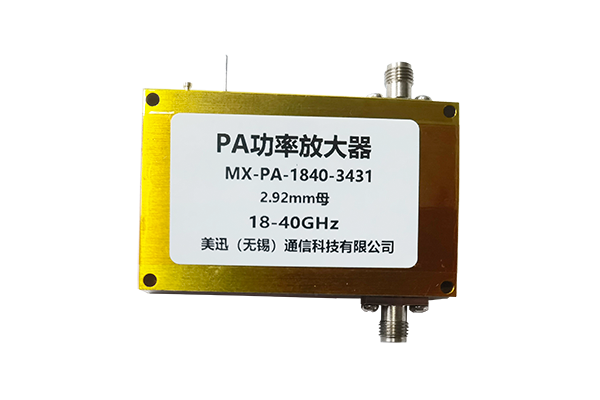
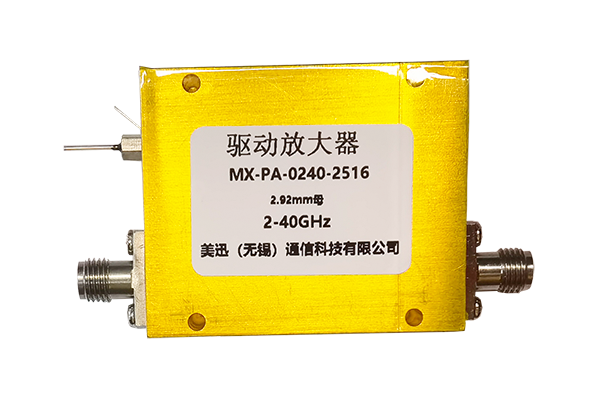
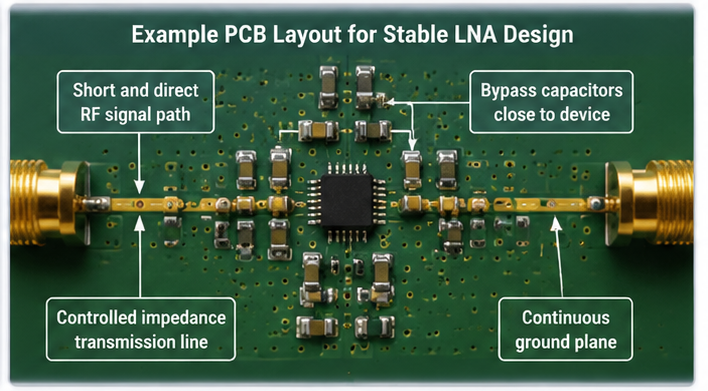
Modern radar systems require extremely high sensitivity, accuracy, and reliability to detect weak signals in complex electromagnetic environments.
A Low Noise Amplifier (LNA) plays a critical role in radar receiver architectures by amplifying low-level RF signals while introducing minimal additional noise.
As the first active component in many radar receiver chains, the LNA directly impacts detection range, signal quality, and overall system performance.
With the development of advanced radar technologies such as phased array radar, AESA radar, automotive radar, and electronic warfare systems,
high-performance RF low noise amplifiers have become essential components for achieving improved receiver sensitivity and signal processing accuracy.
Key Takeaway: A low noise amplifier determines the noise performance of the radar receiver front-end.
Optimizing LNA gain, noise figure, linearity, and bandwidth is essential for modern radar system design.
What Is a Low Noise Amplifier in Radar Systems?
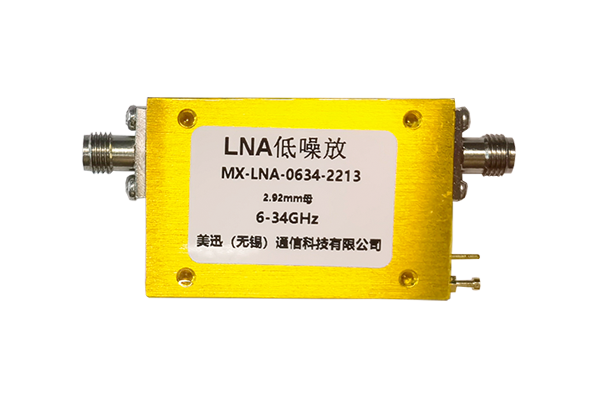
A Low Noise Amplifier is an RF amplifier designed to increase the power level of weak incoming signals while adding as little noise as possible.
In radar receivers, signals reflected from distant targets often have extremely low power levels. Before these signals can be processed by mixers,
filters, and digital signal processors, they must be amplified without significantly degrading their signal-to-noise ratio.
Unlike conventional RF amplifiers, LNAs prioritize low noise figure, high gain stability, and excellent linearity rather than maximum output power.
These characteristics make them ideal for the first stage of radar receiver architectures.
Position of LNA in Modern Radar Receiver Architecture
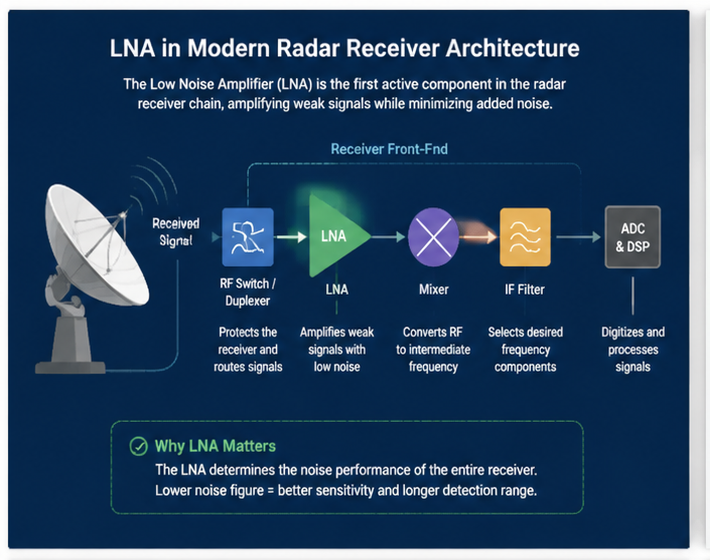
In a typical radar receiver chain, the LNA is located immediately after the antenna or antenna switching network.
Its position is critical because any noise introduced at this stage is amplified by all following receiver components.
|
Receiver Component
|
Main Function
|
|
Antenna
|
Receives weak reflected radar signals
|
|
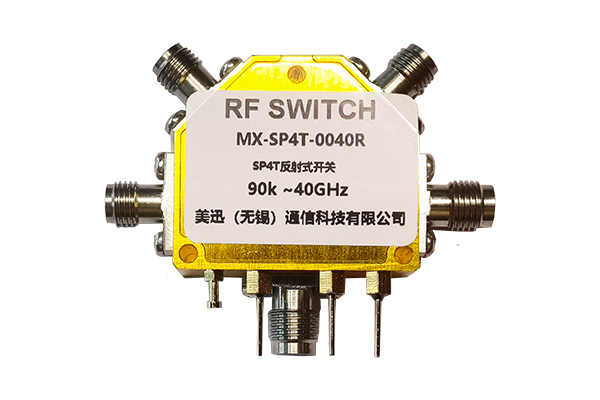
RF Switch / Duplexer
|
Controls signal routing and isolation
|
|
Low Noise Amplifier
|
Provides low-noise signal amplification
|
|
Mixer
|
Converts RF signals to intermediate frequency
|
|
ADC and DSP
|
Digital signal conversion and processing
|
Why Low Noise Amplifiers Are Critical for Radar Performance
1. Improving Radar Receiver Sensitivity
Radar detection capability depends heavily on receiver sensitivity. A lower noise figure allows the receiver to detect weaker target echoes,
increasing the maximum detection range and improving performance in challenging environments.
2. Maintaining High Signal-to-Noise Ratio
Since the LNA is the first amplification stage, its noise characteristics dominate the overall receiver noise performance.
A high-quality RF LNA preserves signal integrity and improves the signal-to-noise ratio throughout the entire receiver chain.
3. Supporting Wideband Radar Applications
Modern radar systems often operate across wide frequency ranges including X-band, Ku-band, and Ka-band.
Wideband low noise amplifiers provide consistent gain and noise performance across broad operating bandwidths.
Key Parameters of Radar Low Noise Amplifiers
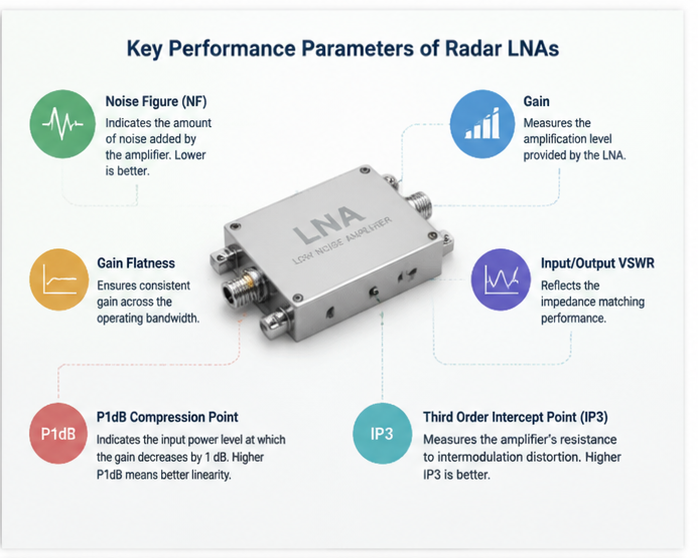
|
Parameter
|
Importance
|
|
Noise Figure
|
Determines how much noise the amplifier adds to the received signal
|
|
Gain
|
Controls signal amplification level
|
|
Gain Flatness
|
Ensures stable amplification across frequency range
|
|
Input/Output VSWR
|
Indicates impedance matching performance
|
|
P1dB Compression Point
|
Defines amplifier linearity under high input power
|
|
Third Order Intercept Point
|
Measures resistance to intermodulation distortion
|
Applications of LNAs in Modern Radar Systems
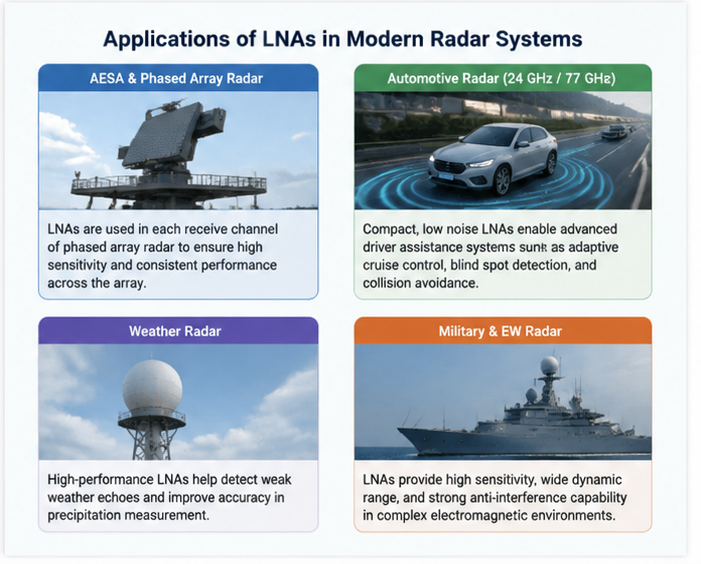
AESA and Phased Array Radar
Active electronically scanned array radar systems use thousands of transmit and receive modules.
Each receive channel requires compact, high-performance LNAs to maintain consistent sensitivity across the array.
Automotive Radar
Automotive radar operating at 24 GHz and 77 GHz requires low noise amplifiers with excellent gain stability and compact packaging.
These LNAs enable advanced driver assistance systems such as adaptive cruise control and collision avoidance.
Military and Electronic Warfare Radar
Defense radar systems require LNAs capable of operating under strong interference, wide dynamic range conditions,
and extreme environmental requirements.
LNA Design Challenges in Radar Receiver Systems
-
Noise Optimization: Achieving extremely low noise figure while maintaining sufficient gain.
-
Linearity Requirements: Preventing signal distortion caused by strong interference signals.
-
Thermal Management: Maintaining stable performance under temperature variations.
-
Frequency Scaling: Designing high-performance LNAs for millimeter-wave radar frequencies.
Future Trends of Low Noise Amplifiers for Radar
Future radar architectures will demand smaller, faster, and more efficient RF components.
Semiconductor technologies such as GaAs, GaN, and advanced CMOS processes are enabling higher-frequency LNAs with improved reliability.
Integration of LNAs with RF switches, mixers, and beamforming circuits is also becoming increasingly important for compact phased array radar systems.
Frequently Asked Questions
What does a low noise amplifier do in a radar receiver?
A low noise amplifier increases weak radar signals while adding minimal noise, improving receiver sensitivity and detection performance.
Why is noise figure important for radar LNAs?
Noise figure directly affects the receiver's ability to detect weak signals. Lower noise figure improves radar range and accuracy.
What frequency bands use radar LNAs?
Radar LNAs are widely used in L-band, S-band, C-band, X-band, Ku-band, Ka-band, and millimeter-wave radar applications.
Conclusion
Low Noise Amplifiers are fundamental building blocks in modern radar receiver architectures.
By providing high gain with minimal noise contribution, LNAs improve radar sensitivity, detection range, and signal processing accuracy.
As radar systems continue evolving toward higher frequencies, wider bandwidths, and more complex architectures,
advanced RF low noise amplifier technology will remain essential for next-generation radar applications.