



The Difference Between SMB and SMA connector

SMB and SMA are two of the most common coaxial RF connectors, but they differ in size, frequency range, mating mechanism, and intended use. Choosing the wrong one can cause mechanical incompatibility, signal loss, or system failure.

Quick Answer

SMA is a threaded RF connector operating from DC to 18 GHz, ideal for test equipment, instruments, and high-frequency designs. SMB is a smaller snap-on (push-on) connector operating from DC to 4 GHz, designed for dense PCB layouts and quick-connect applications. They are not mechanically compatible. Use SMA when you need high frequency or precision; use SMB when you need small size and fast mating.

Quick Comparison

SMA (Sub-Miniature A)

  • Coupling: threaded (hex nut)
  • Frequency: DC – 18 GHz
  • Impedance: 50 Ω
  • Mating: 6 turns to engage
  • Size: medium
  • Durability: 500+ cycles
  • Use: test, instrument, RF modules

SMB (Sub-Miniature B)

  • Coupling: snap-on (push)
  • Frequency: DC – 4 GHz
  • Impedance: 50 Ω (also 75 Ω)
  • Mating: push and snap
  • Size: smaller (≈ 70 % of SMA)
  • Durability: 500 cycles
  • Use: dense PCBs, telecom, GPS, cellular

Mechanical Design

SMA Connector

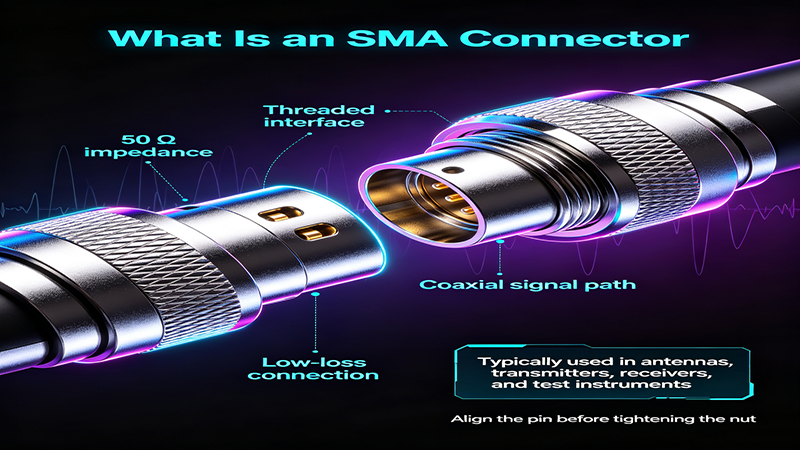
The SMA connector uses a 1/4"-36 UNS threaded coupling. A hex nut tightens onto the mating connector with a recommended torque of 5 in-lbs (0.56 N·m). The threaded design provides excellent mechanical stability and repeatable electrical performance, but mating takes about six turns.

SMB Connector

The SMB connector uses a snap-on coupling mechanism. The male connector is pushed straight into the female receptacle until it clicks into place. A small release tool or straight pull is needed to unmate. SMB is much faster to connect than SMA, but provides less mechanical rigidity.

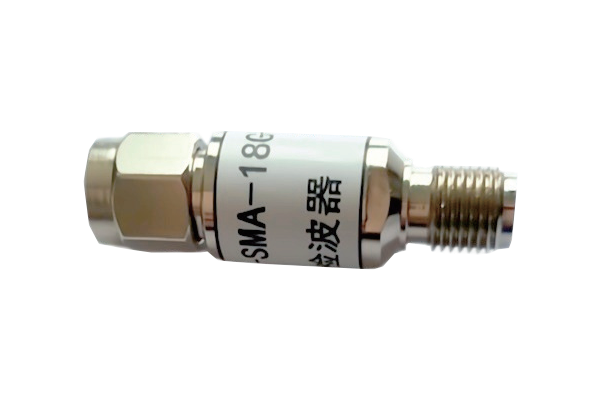
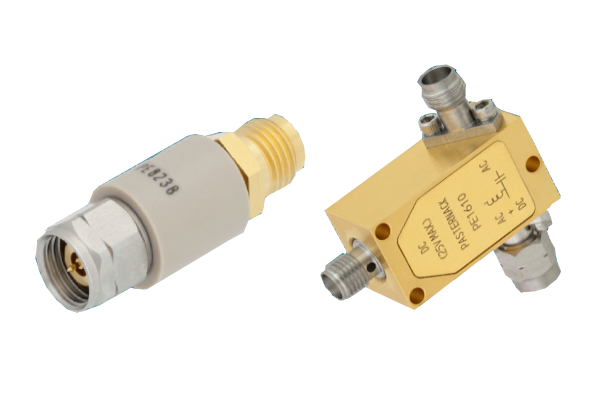
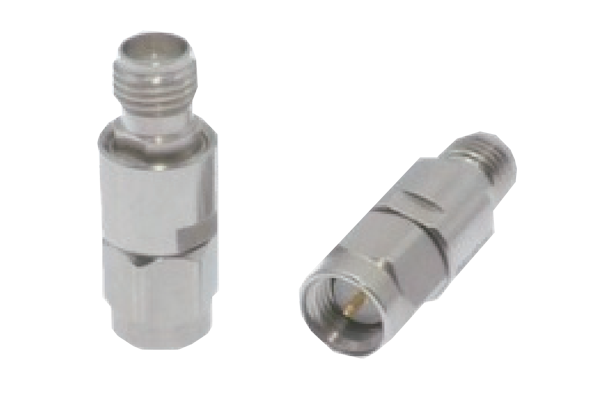
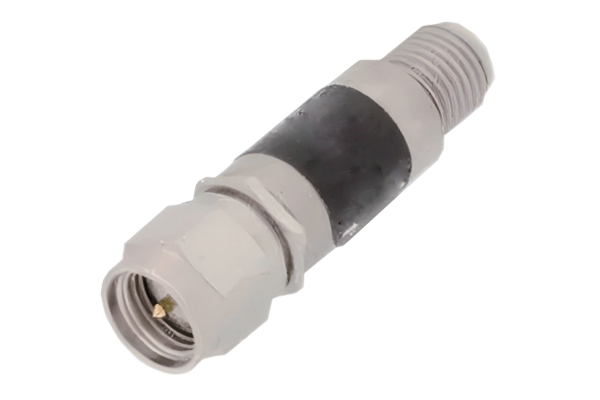
SMA (left) and SMB (right) — Size Comparison

SMA Connector SMB Connector Threaded coupling 6 turns to mate Snap-on coupling Push & snap

SMA's threaded coupling requires multiple rotations to mate; SMB snaps on with a single push. The SMB body is also smaller, allowing denser PCB layouts.

Electrical Performance

Specification SMA SMB
Frequency Range DC – 18 GHz (precision up to 26.5 GHz) DC – 4 GHz (typically)
Impedance 50 Ω 50 Ω or 75 Ω
VSWR (DC – 4 GHz) ≤ 1.10:1 ≤ 1.30:1
VSWR (4 – 18 GHz) ≤ 1.25:1 N/A
Insertion Loss (DC – 4 GHz) ≤ 0.05 dB ≤ 0.10 dB
Insertion Loss (4 – 18 GHz) ≤ 0.20 dB N/A
Dielectric Withstanding 1,000 V RMS 1,000 V RMS
Insulation Resistance ≥ 5 GΩ ≥ 1 GΩ
Center Contact Resistance ≤ 3 mΩ ≤ 6 mΩ

Mechanical Specifications

  • Vibration Tolerance
  • Specification SMA SMB
    Mating Cycles 500 minimum 500 minimum
    Engagement Force 2 in-lbs torque Push & snap (no torque)
    Disengagement Force Torque required Straight pull, ~ 8 N
    Body Size (typical) ~ 9 mm hex ~ 6 mm
    Locking Mechanism Hex nut + thread Snap latch
    Excellent Good

    Advantages of SMB

    • Fast mating: snap-on saves installation effort in dense layouts.
    • Small size: about 30 % smaller than SMA; excellent for tight PCBs.
    • Cost-effective: cheaper in volume than SMA.
    • No torque wrench needed: no special tools for installation.

    Advantages of SMA

    • Higher frequency: up to 18 GHz, suitable for microwave designs.
    • Better mechanical stability: threaded coupling holds firmly under vibration.
    • Better electrical performance: lower VSWR and insertion loss above 4 GHz.
    • Wide standard adoption: standard in test equipment and instrumentation.

    Common Applications

    SMA Applications

    • Test and measurement equipment (VNA, spectrum analyzer).
    • RF modules and lab instruments.
    • Microwave components (amplifiers, filters, attenuators).
    • GPS antennas at L1 / L2.
    • Aerospace and defense electronics.

    SMB Applications

    • Cellular base station boards.
    • GPS receivers and modules.
    • Wireless LAN cards and PCMCIA.
    • Telecom equipment backplanes.
    • Automotive infotainment and telematics.
    • Industrial control boards with RF connectivity.
    Tip: SMB is also available in 75 Ω for video and broadcast applications (DSMB / SMB-75). Make sure to use the right impedance for your system.

    Are SMB and SMA Compatible?

    No. SMB and SMA have different mechanical interfaces:

    • SMA uses a 1/4"-36 UNS thread with a hex nut.
    • SMB uses a snap-on coupling with a smaller diameter.

    You cannot mate an SMA plug with an SMB jack, or vice versa. For conversion between the two, use a high-quality SMA-to-SMB adapter. Adapters add small amounts of loss and VSWR but are usually acceptable below 4 GHz.

    How to Choose Between SMA and SMB

  • Test and measurement
  • Scenario Recommendation
    Frequency above 4 GHz SMA
    Frequency below 4 GHz SMB or SMA
    Dense PCB, hundreds of connections SMB
    SMA
    High-vibration environment SMA
    Fast field service / push-on SMB
    Lowest cost at volume SMB
    Maximum mechanical reliability SMA

    Common Mistakes

    • Forcing SMA into SMB: mechanical incompatibility damages both connectors.
    • Exceeding SMB frequency rating: performance degrades above 4 GHz.
    • Over-torquing SMA: damages the male pin or hex nut.
    • Forgetting snap-release on SMB: pulling by the cable instead of using a release tool damages the connector.
    • Mismatched impedance: using 50 Ω and 75 Ω versions on the same line.

    Key Takeaways

    • SMA is threaded and goes to 18 GHz; SMB is snap-on and goes to 4 GHz.
    • SMB is smaller and faster to install; SMA is more robust and higher frequency.
    • They are not mechanically compatible; use adapters when needed.
    • Choose SMA for high-frequency or precision; choose SMB for density and cost.
    • Always respect the rated frequency and mechanical engagement.

    Frequently Asked Questions

    What is the difference between SMB and SMA?

    SMA is a threaded RF connector with frequency range DC – 18 GHz. SMB is a smaller snap-on connector with frequency range DC – 4 GHz. They differ in size, mating style, and electrical performance.

    Are SMB and SMA compatible?

    No. They have different mechanical interfaces. SMA has a threaded coupling; SMB has a snap-on coupling. Use an adapter when needed.

    What is SMB used for?

    SMB is widely used in cellular base station boards, GPS modules, automotive telematics, and dense PCB layouts where space is limited.

    What is SMA used for?

    SMA is standard in laboratory test equipment (VNA, spectrum analyzer), RF modules, microwave components, and high-frequency designs.

    Which is better for a 5 GHz Wi-Fi design?

    SMA. SMB performance degrades rapidly above 4 GHz, while SMA is rated to 18 GHz. SMA's threaded coupling also handles mechanical stress better.
    • What is an N-Type Connector?
      What is an N-type connector? Learn about the N-type coaxial RF connector — its origin, mechanical design, electrical performance, common variants, and applications up to 18 GHz.
      Sep 09 ,26
    • Radio Frequency Connector Classification
      Comprehensive guide to radio frequency connector classification. Learn about SMA, BNC, N-Type, TNC, MCX connectors, their applications, specifications, and how to choose the right RF connector.
      Sep 08 ,26
    • Optimizing RF Connector: Performance Degradation Due to Wear and Tear
      RF connectors are critical interfaces in microwave, wireless communication, radar, test and measurement, satellite, and high-freque...
      Sep 08 ,26
    • What Are 1.5-3.5 Connectors?
      1.5-3.5 connectors are high-frequency coaxial RF connectors designed for demanding microwave and millimeter-wave applications.
      Sep 04 ,26
    • What are QMA Connectors?
      What are QMA connectors? Learn about the QMA quick-lock RF connector — its features, electrical performance, mechanical specifications, and how it compares to SMA and other RF connectors.
      Sep 03 ,26
    • What Is an SMB Connector? A Comprehensive Guide
      Learn what an SMB connector is, its specifications, applications, and how it compares to SMA and SMC connectors in this comprehensive guide.
      Aug 24 ,26
    • What Is an RF Connector?
      In this guide, you will learn what an RF connector is, how it works, the different types of RF connectors, their applications, and how to choose the right connector for your RF or microwave system.
      Aug 22 ,26
    • What Is an SMA Connector? Everything You Need to Know
      An SMA connector, short for SubMiniature version A connector, is a compact threaded coaxial RF connector widely used for transmitting high-frequency signals.
      Aug 22 ,26
    • How to Choose the Right RF Connector for Your Application
      Learn how to select RF connectors based on frequency range, impedance, VSWR, power handling, connector types, mechanical constraints, and environmental conditions.
      Aug 14 ,26

    About the Author — MeiXun Team

    Wang

    Chief Engineer Wang

    High-tech Enterprise, Feifeng Talent

    Chief Engineer Wang graduated with a master's degree in high-power microwave from the Institute of Electronics, University of Chinese Academy of Sciences.

    View Full Profile
    Wang

    Chief Engineer Wang

    High-tech Enterprise, Feifeng Talent

    Chief Engineer Wang graduated with a master's degree in high-power microwave from the Institute of Electronics, University of Chinese Academy of Sciences.

    In the same year, he joined CETC 40/41 for work and study. He has been committed to the design and development of microwave switches for a long time.

    He has applied for 27 patents as the first inventor in the microwave switch field, with 6 authorized invention patents and 14 utility model patents.

    The products he developed cover various application platforms such as civilian testing, vehicle-mounted, shipborne, airborne, and missile-borne.

    RF Microwave Switch RF Switch Coaxial Switch PIN Diode Switch Low Noise Amplifier Waveguide Switch PIN Switch Microwave Switch