1. Introduction to SPST Switches
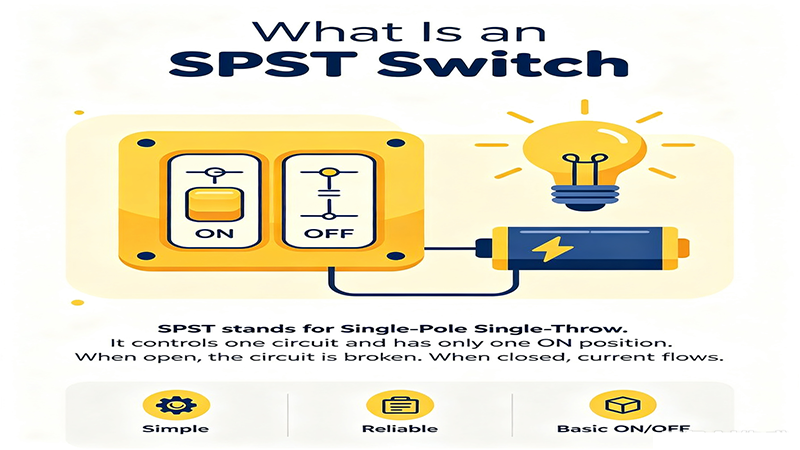
A Single-Pole Single-Throw (SPST) switch is the most fundamental type of electrical switch used in modern circuit design. It functions as a simple on-off device, controlling the flow of current through a single conductor path. When the switch is in the "closed" position, current flows freely; when "open," the circuit is broken and no current passes. This binary operation makes the SPST switch an indispensable building block in countless electrical systems, ranging from household appliances to sophisticated industrial controls.
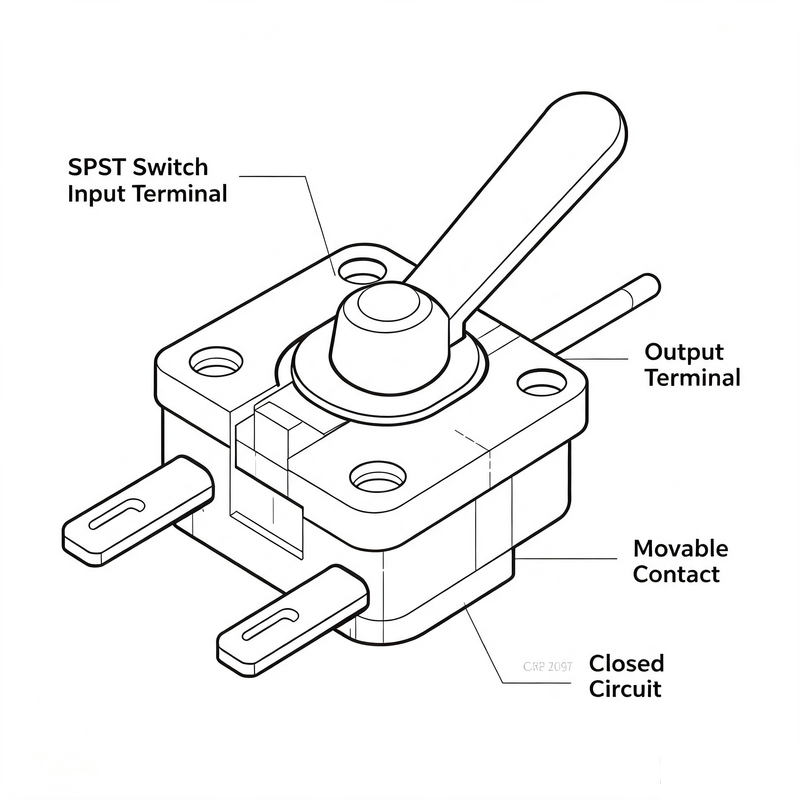
Despite its simplicity, the SPST switch plays a critical role in ensuring safety, energy efficiency, and operational control across diverse applications. Its design consists of two terminals: one for the incoming power source and one for the outgoing load connection. A mechanical actuator — such as a toggle, rocker, push-button, or slide mechanism — physically moves a conductive contact to either complete or interrupt the circuit.
2. How an SPST Switch Works
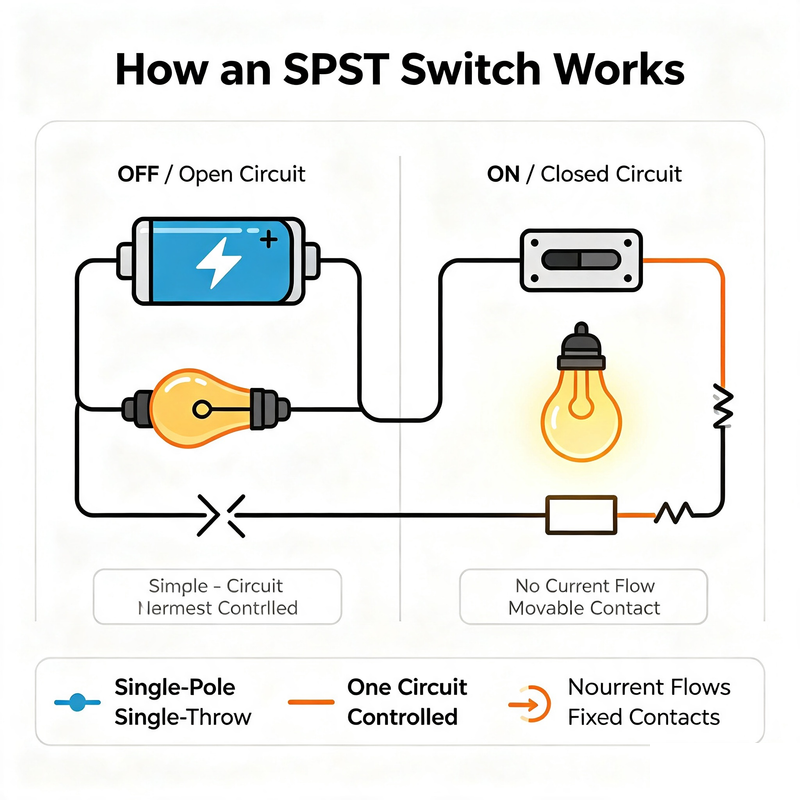
The operational principle of an SPST switch is elegantly straightforward. Inside the switch housing, a movable conductive element — often made of copper alloy or silver-plated brass — makes contact with two stationary terminals. When the actuator is toggled to the "ON" position, the conductive element bridges the gap between the two terminals, allowing electrons to flow through the circuit. When the actuator is moved to the "OFF" position, the conductive element is physically separated from at least one terminal, creating an air gap that interrupts current flow.
This air gap is a crucial safety feature, as it provides galvanic isolation between the power source and the load when the switch is open. The gap distance is engineered to withstand the maximum voltage rating of the switch, preventing arc-over and ensuring reliable disconnection even under demanding conditions. Many SPST switches also feature spring-loaded mechanisms that provide a positive "snap" action, reducing contact bounce and extending the switch's operational lifespan.
Key Insight: The SPST switch is a two-terminal device — one terminal connects to the power source, and the other connects to the load. It controls only a single circuit path, which distinguishes it from multi-pole and multi-throw switch variants.
3. Key Benefits of SPST Switches in Electrical Systems
SPST switches offer numerous advantages that make them the preferred choice for basic on-off control in a wide array of electrical applications. Below are the primary benefits that contribute to their widespread adoption.
3.1 Simplicity and Reliability
The SPST switch contains only one moving contact mechanism, which translates directly into higher reliability. Fewer mechanical parts mean fewer potential points of failure, resulting in a longer service life and more consistent performance over thousands of switching cycles. This inherent simplicity also makes SPST switches easy to install, troubleshoot, and replace.
3.2 Cost-Effectiveness
Because SPST switches require fewer components and less complex manufacturing processes compared to multi-pole or multi-throw switches, they are significantly more affordable. For applications that only require basic on-off functionality, selecting an SPST switch provides the most economical solution without sacrificing quality or reliability.
3.3 Compact Design and Versatile Mounting
SPST switches are available in a remarkably compact form factor, making them ideal for space-constrained applications such as handheld devices, control panels, and automotive dashboards. They are manufactured in a wide variety of physical configurations including toggle, rocker, slide, push-button, rotary, and tactile formats, allowing designers to select the perfect actuator style for any user interface.
3.4 High Current and Voltage Ratings
Despite their simple construction, SPST switches can be engineered to handle substantial electrical loads. Industrial-grade SPST switches are available with current ratings exceeding 100 amperes and voltage ratings up to 600 volts or more. This scalability makes them suitable for everything from low-power signal circuits to high-power industrial equipment.
3.5 Clear Operational State
SPST switches provide unambiguous on-off status, which is essential for safety-critical applications. Many models feature visual indicators such as illuminated actuators, color-coded positions, or label plates, ensuring operators can quickly identify whether the circuit is energized or disconnected.
3.6 Minimal Signal Distortion
In signal-switching applications, SPST switches introduce negligible resistance and capacitance when closed, preserving signal integrity. High-quality SPST switches used in audio and RF applications are designed with gold-plated contacts and low-insertion-loss materials to minimize signal degradation.
4. Common Applications of SPST Switches
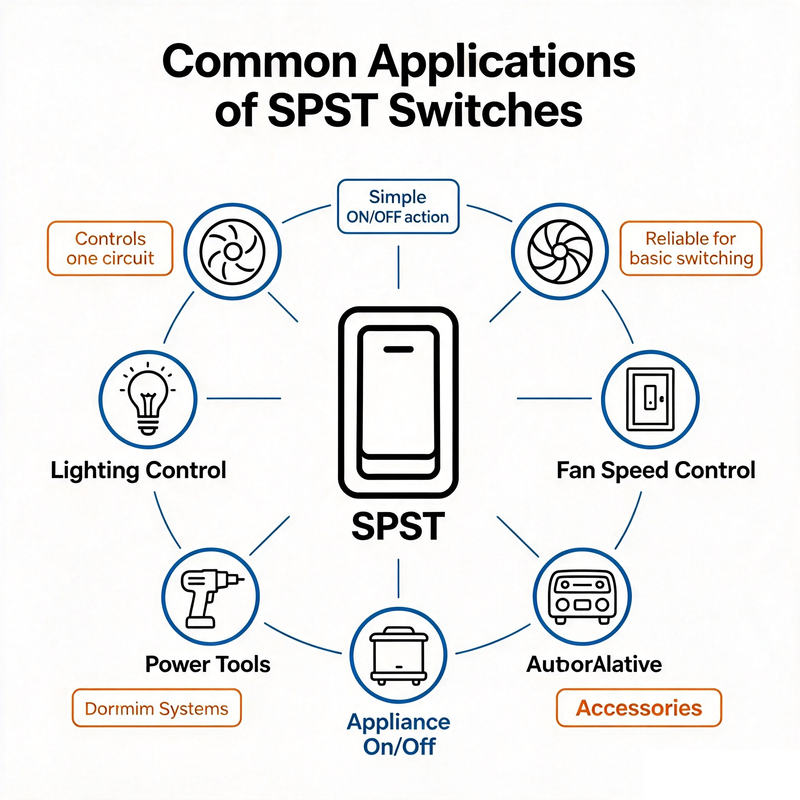
The versatility of SPST switches is demonstrated by their presence in virtually every sector of electrical engineering. Below are the most common application areas.
4.1 Consumer Electronics
SPST switches are ubiquitous in consumer devices, serving as power buttons on televisions, radios, gaming consoles, and audio equipment. They are also found in household appliances such as coffee makers, toasters, and electric kettles, where they function as primary power switches or safety interlocks.
4.2 Automotive and Transportation
In vehicles, SPST switches control a variety of functions including headlights, windshield wipers, horn activation, and interior lighting. They are selected for their durability, resistance to vibration, and ability to operate reliably across a wide temperature range. Automotive SPST switches often feature sealed housings to protect against moisture and dust ingress.
4.3 Industrial Control Systems
Industrial machinery relies on SPST switches for emergency stop buttons, motor start/stop controls, limit switches, and equipment isolation. These switches are typically rated for higher voltages and currents, and they are often housed in rugged enclosures that meet NEMA or IP protection standards for harsh environments.
4.4 Medical Equipment
Medical devices such as patient monitors, diagnostic instruments, and therapeutic equipment use SPST switches for power control and mode selection. In this domain, SPST switches must meet stringent regulatory requirements for safety, reliability, and electromagnetic compatibility (EMC).
4.5 Lighting Systems
Residential and commercial lighting circuits frequently employ SPST switches as standard wall-mounted light switches. They provide simple on-off control for individual fixtures or groups of lights. Modern smart lighting systems may use SPST relays as the switching element, allowing electronic control while maintaining the simplicity of a mechanical SPST interface.
4.6 Test and Measurement Equipment
Laboratory instruments and test equipment often incorporate SPST switches for range selection, signal routing, and calibration functions. In these applications, precision SPST switches with low contact resistance and high repeatability are essential for accurate measurements.
5. SPST Switch vs. Other Switch Configurations
Understanding how SPST switches compare to other common switch types helps engineers select the appropriate component for their specific application. The table below highlights the key differences.
|
Switch Type
|
Poles
|
Throws
|
Typical Use Case
|
Complexity
|
|
SPST
|
1
|
1
|
Simple on-off control, power switching
|
Lowest
|
|
SPDT
|
1
|
2
|
Selecting between two circuits (e.g., A/B switch)
|
Low
|
|
DPST
|
2
|
1
|
Simultaneous switching of two isolated circuits
|
Medium
|
|
DPDT
|
2
|
2
|
Reversing polarity, multi-circuit selection
|
Medium-High
|
|
3PST / 3PDT
|
3
|
1-2
|
Three-phase power control, complex routing
|
High
|
For applications requiring only basic on-off functionality, the SPST switch is almost always the optimal choice due to its lower cost, smaller size, and simpler integration. More complex switch types should only be selected when the additional poles or throws are genuinely required by the circuit design.
6. Key Factors for Selecting an SPST Switch
Choosing the right SPST switch for a specific application requires careful consideration of several electrical, mechanical, and environmental parameters. The following criteria should guide the selection process.
-
Current Rating (Amperes): The switch must be capable of handling the maximum continuous current drawn by the load without overheating. Select a switch with a current rating at least 20-30% higher than the expected maximum load.
-
Voltage Rating (Volts AC/DC): The switch's voltage rating must exceed the circuit's operating voltage. DC voltage ratings are often lower than AC ratings for the same switch due to arc-suppression characteristics.
-
Actuator Type: Choose from toggle, rocker, push-button, slide, rotary, or tactile styles based on user-interface requirements, ergonomics, and mounting constraints.
-
Mounting Configuration: Consider whether the switch will be panel-mounted, PCB-mounted, surface-mounted, or chassis-mounted. Common mounting styles include threaded bushing, snap-in, and through-hole PCB terminals.
-
Contact Material: Silver alloy contacts are suitable for power switching, while gold-plated contacts are preferred for low-level signal switching to prevent oxidation and ensure reliable low-current operation.
-
Environmental Protection: For harsh environments, select switches with sealed housings, IP-rated ingress protection, and temperature ratings compatible with the operating environment.
-
Mechanical Life Expectancy: The switch should be rated for a sufficient number of mechanical cycles. High-quality SPST switches can withstand 50,000 to 100,000+ operations before failure.
-
Compliance and Certifications: Verify that the switch meets relevant safety standards such as UL, CSA, VDE, or CE for the target market and application.
7. Installation and Safety Best Practices
Proper installation of SPST switches is essential for safe and reliable operation. Always disconnect power before installing or replacing any switch, and follow these best practices to ensure optimal performance and longevity.
-
Wire Gauge Compatibility: Ensure the wire gauge matches the switch terminal capacity and the circuit's current requirements. Undersized wiring can cause overheating and voltage drop.
-
Proper Torque on Terminals: Tighten screw terminals to the manufacturer's recommended torque specification. Over-tightening can damage threads or crack terminal housings, while under-tightening can cause arcing and overheating.
-
Polarity Awareness: Although SPST switches are non-polarized, always connect the power source to the terminal that is least likely to be accidentally touched, improving safety during maintenance.
-
Arc Suppression: For inductive loads such as motors or solenoids, consider adding a snubber circuit or freewheeling diode across the load to reduce contact arcing and extend switch life.
-
Periodic Inspection: Regularly inspect switches for signs of wear, discoloration, loose connections, or unusual heating. Replace any switch that shows signs of degradation.
Safety Reminder: Never exceed the manufacturer's specified current and voltage ratings. Operating an SPST switch beyond its rated capacity can lead to contact welding, fire hazards, or catastrophic failure of the electrical system.
Conclusion
The SPST switch stands as one of the most essential and versatile components in electrical engineering. Its elegant simplicity, exceptional reliability, and cost-effectiveness make it the go-to solution for basic on-off control across an extraordinary range of applications — from everyday household appliances to sophisticated industrial automation systems.
By understanding the operating principles, benefits, and selection criteria outlined in this article, engineers and technicians can confidently specify the right SPST switch for any project. Whether you are designing a new consumer product, upgrading industrial equipment, or performing maintenance on existing systems, the SPST switch remains an indispensable tool in your electrical engineering toolkit.
When simplicity meets reliability, the SPST switch proves that sometimes the most basic solution is also the most effective.