






RF Switch Selection Guide: How to Choose the Best Microwave Switch for Your Application
Selecting the right RF switch is critical for achieving reliable signal routing, low insertion loss, high isolation, and stable performance in modern RF and microwave systems. With many options including coaxial switches, PIN diode switches, solid-state switches, and electromechanical switches, engineers need to carefully evaluate electrical specifications, frequency requirements, switching speed, and application conditions.
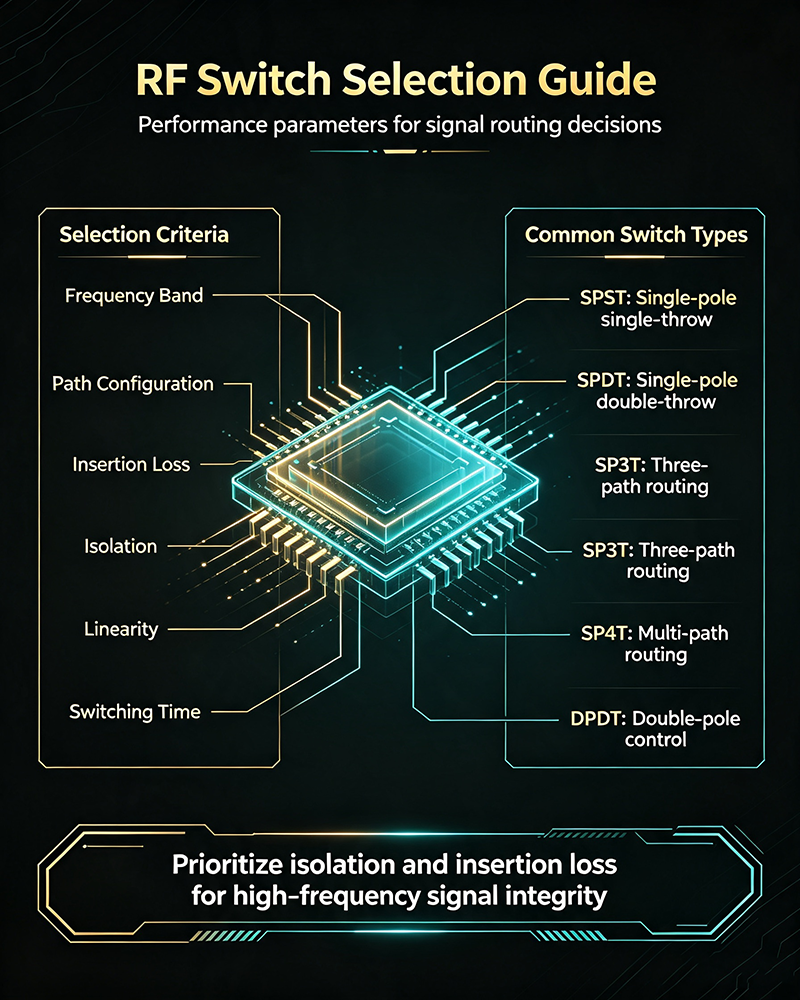
This RF Switch Selection Guide explains the key factors to consider when choosing the best microwave switch for radar systems, wireless communication, satellite equipment, test and measurement systems, and other high-frequency applications.
What Is an RF Switch?
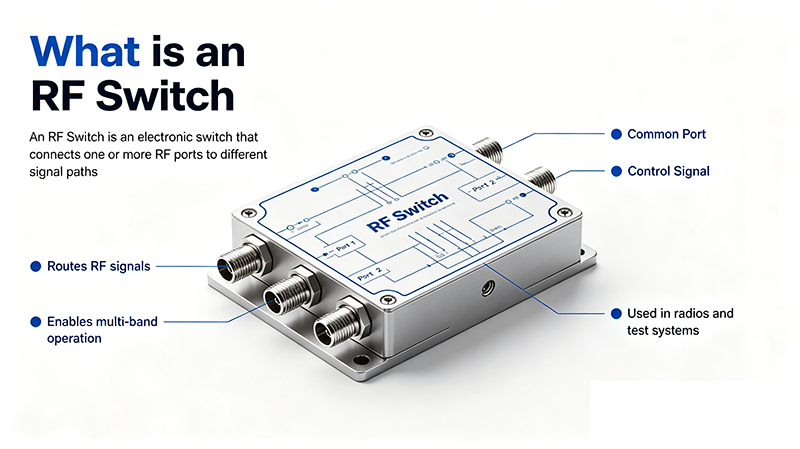
An RF switch is an electronic component used to control the transmission path of radio frequency signals. It allows one RF signal to be connected between multiple ports or enables multiple RF channels to be selected within a system.
Unlike traditional low-frequency switches, RF microwave switches must maintain signal integrity at high frequencies while providing excellent isolation and minimal signal loss.
- 5G and wireless communication systems
- Radar and electronic warfare systems
- Satellite communication equipment
- RF test and measurement instruments
- Antenna switching networks
- Microwave laboratory systems
Types of RF Microwave Switches
1. Electromechanical RF Switches
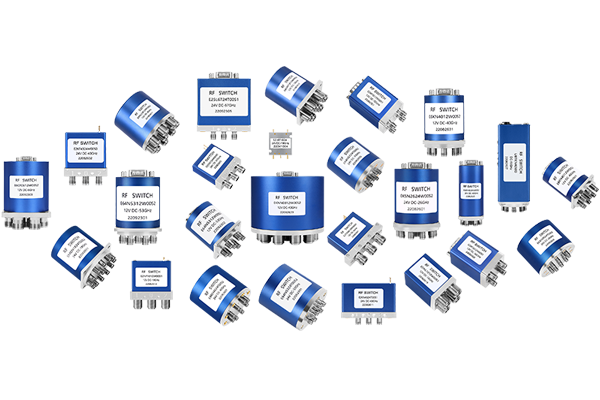
Electromechanical RF switches use mechanical contacts to physically connect or disconnect RF paths. They are widely used in applications requiring excellent isolation, high power handling, and low insertion loss.
Advantages:
- Excellent RF performance
- High isolation between channels
- High power capability
- Wide frequency coverage
Applications include automated test equipment, aerospace systems, and high-performance microwave networks.
2. PIN Diode RF Switches
PIN diode switches use semiconductor devices to control RF signal transmission. They provide extremely fast switching speed and are suitable for applications requiring rapid signal routing.
Advantages:
- Fast switching speed
- No mechanical movement
- High reliability
- Compact size
3. Solid-State RF Switches
Solid-state RF switches use semiconductor technologies such as GaAs, CMOS, or MEMS. They provide long operational life and are suitable for compact RF systems.
Key Factors for RF Switch Selection
1. Frequency Range
The operating frequency is one of the most important factors when selecting an RF switch. The switch must support the complete frequency range of the application without excessive signal degradation.
For example:
- HF/VHF/UHF systems require lower frequency switches
- Microwave communication systems may require switches above 18 GHz
- Advanced radar systems may require millimeter-wave switches above 40 GHz
2. Insertion Loss
Insertion loss represents the amount of RF signal power lost when the switch is in the ON state.
A lower insertion loss value means better signal efficiency and improved system performance.
High-performance microwave switches typically require insertion loss values below 1 dB depending on frequency requirements.
3. Isolation
Isolation describes how effectively an RF switch prevents unwanted signals from leaking between ports.
High isolation is especially important in:
- Radar systems
- Multi-channel communication systems
- RF measurement equipment
4. Switching Speed
Switching speed determines how quickly an RF switch can change between signal paths.
| Switch Type | Typical Switching Speed |
|---|---|
| Electromechanical Switch | Milliseconds range |
| PIN Diode Switch | Nanoseconds to microseconds |
| Solid-State Switch | Microseconds or faster |
5. Power Handling Capability
RF switches used in transmit systems must handle high RF power levels without damage or performance degradation.
Important specifications include:
- Maximum input power
- Peak power rating
- Average power rating
- VSWR under power conditions
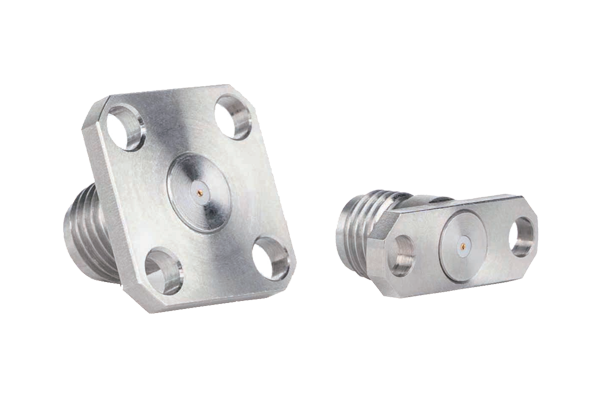
6. Connector Type and Mechanical Configuration
The connector interface affects installation compatibility and RF performance.
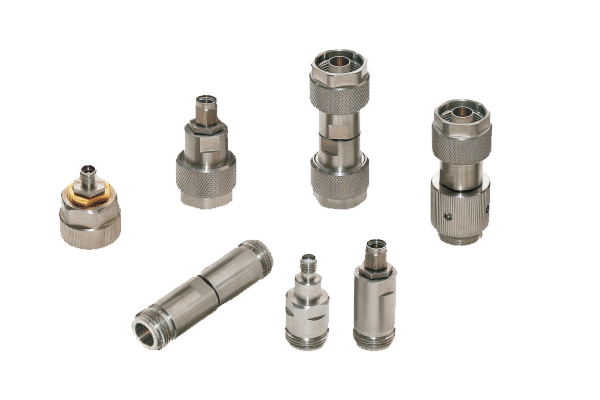
Common RF switch connectors include:
- SMA
- 2.92 mm
- 2.4 mm
- N-Type
- TNC
Common RF Switch Configurations
| Configuration | Description | Application |
|---|---|---|
| SPST | Single Pole Single Throw | Simple RF signal control |
| SPDT | Single Pole Double Throw | Antenna switching |
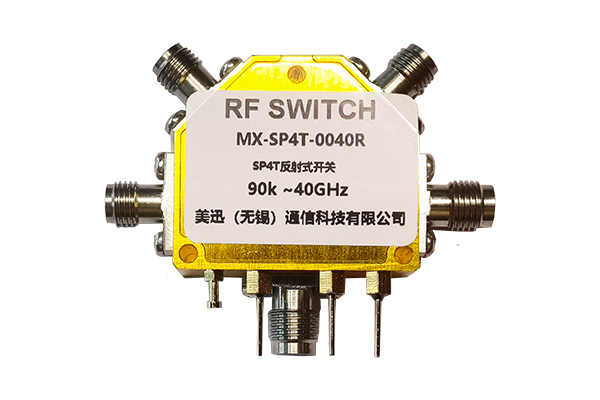
| SP4T | Single Pole Four Throw | Multi-channel routing |
| SP6T/SP12T | Multiple channel switching | Test systems and communication equipment |
How to Choose the Right RF Switch for Your Application?
A practical RF switch selection process should follow these steps:
- Step 1: Define the operating frequency range.
- Step 2: Determine required switching configuration such as SPDT, SP4T, SP6T, or SP12T.
- Step 3: Check insertion loss and isolation requirements.
- Step 4: Evaluate switching speed and lifetime requirements.
- Step 5: Confirm power handling capability.
- Step 6: Select a reliable RF microwave switch manufacturer.
RF Switch Applications
Radar Systems
Radar systems require RF switches with high isolation, fast response, and excellent repeatability for signal routing and antenna control.
5G Wireless Communication
RF switches enable antenna selection, beamforming networks, and frequency band switching in advanced wireless systems.
Satellite Communication
Satellite systems require high reliability RF switches capable of operating under demanding environmental conditions.
RF Test Equipment
Automated test systems use microwave switches to create flexible signal routing networks for device testing.
How to Select a Reliable RF Microwave Switch Manufacturer?
Choosing the right supplier is as important as selecting the correct RF switch specification.
A professional RF microwave switch manufacturer should provide:
- Complete RF performance specifications
- Frequency coverage from MHz to GHz ranges
- Customized RF switch solutions
- Strict quality control testing
- Technical support and application guidance
Frequently Asked Questions About RF Switch Selection
What is the most important RF switch specification?
Frequency range, insertion loss, isolation, switching speed, and power handling are the most important parameters. The priority depends on the specific application.
Which RF switch is best for high-frequency applications?
Electromechanical and PIN diode switches are commonly used for high-frequency microwave applications because they provide excellent RF performance.
What is the difference between coaxial switch and RF switch?
A coaxial switch is a type of RF switch designed specifically for coaxial transmission lines. RF switches include a broader range of technologies and configurations.
Conclusion
Selecting the right RF microwave switch requires a complete understanding of frequency range, insertion loss, isolation, switching speed, power handling, and system requirements.
Whether you need a coaxial switch, PIN diode switch, or customized microwave switching solution, working with an experienced RF switch manufacturer ensures better performance, reliability, and long-term system stability.
About the Author — MeiXun Team
Chief Engineer Wang
High-tech Enterprise, Feifeng Talent
Chief Engineer Wang graduated with a master's degree in high-power microwave from the Institute of Electronics, University of Chinese Academy of Sciences.
View Full Profile- RF Switch Circuit Diagram
- RF Switch
- Ohm's Law
- dBm to Watt
- mW to dBm
- Wavelength to Frequency
- RF Connector
- SMA Connector
- RF Switch Module
- RF Coupler
- RF PIN Switch
- Microwave Coaxial Switch
- PIN Switch
- Coaxial RF Switch
- Waveguide Switch
- Microwave Switch
- Low Noise Amplifier
- PIN Diode Switch
- Coaxial Switch
- RF Microwave Switch
- SPST Switch