






What is Direct Sequence Spread Spectrum?
Direct Sequence Spread Spectrum (DSSS) is a spread-spectrum communication technique that distributes an information signal over a much wider bandwidth using a high-rate pseudorandom code. Learn how DSSS works, its advantages, limitations, applications, and how it compares with other wireless communication technologies.
Direct Sequence Spread Spectrum (DSSS) is a digital communication technology designed to improve signal robustness, interference resistance, and communication reliability. Instead of transmitting an information signal directly over a relatively narrow bandwidth, DSSS combines the data with a high-speed pseudorandom spreading sequence. This process expands the transmitted signal across a significantly wider frequency range.
At the receiver, the same spreading code is used to perform despreading. The desired signal is reconstructed while signals that do not use the correct code remain distributed across the wider bandwidth and are substantially less significant after correlation.
How Does Direct Sequence Spread Spectrum Work?
The fundamental principle of DSSS is the multiplication of the information-bearing signal by a much higher-rate spreading sequence. The spreading sequence is commonly called a pseudorandom noise (PN) sequence, spreading code, or pseudonoise code.
Original digital information is generated.
A high-rate pseudorandom sequence is generated.
The data is combined with the spreading sequence.
The receiver applies the synchronized code to recover the data.
1. Data Generation
The transmitter begins with a digital information stream. Depending on the system, this may contain voice, sensor information, control data, video, or other digital content.
2. Generation of the PN Sequence
A pseudorandom sequence is generated at a much higher chip rate than the original information bit rate. Each element of this sequence is generally called a chip.
The ratio between the chip rate and the data rate is an important parameter known as the processing gain.
When expressed in decibels, the processing gain can be approximated as:
where Rc is the chip rate and Rb is the information bit rate.
3. Spreading the Data
The information data is combined with the PN sequence. In a binary DSSS system, this operation can be represented as multiplication between the data waveform and the spreading waveform.
The resulting signal contains much more rapid transitions than the original data signal. Consequently, its energy is distributed across a wider frequency bandwidth.
4. RF Modulation and Transmission
After spreading, the signal can be modulated onto an RF carrier and transmitted through an antenna or another communication medium. The transmitted waveform occupies substantially more bandwidth than the original information signal.
5. Despreading at the Receiver
The receiver generates a synchronized copy of the spreading code. By correlating the received signal with this code, the desired signal is compressed back toward its original information bandwidth.
This correlation property is central to DSSS. A properly synchronized receiver can distinguish the intended signal from many unrelated signals and forms of interference.
What Is a DSSS Spreading Code?
A DSSS spreading code is a deterministic sequence that appears random to an observer without knowledge of the code. Although it may look like noise, the transmitter and receiver are designed to generate or recognize the same sequence.
Good spreading codes have desirable autocorrelation and cross-correlation characteristics. These properties allow a receiver to identify the desired signal while reducing the influence of signals using different codes or having poor correlation with the desired sequence.
Autocorrelation
Autocorrelation describes how closely a spreading sequence matches a delayed version of itself. Good autocorrelation characteristics help the receiver synchronize with the transmitted signal.
Cross-Correlation
Cross-correlation describes the similarity between different spreading codes. Low cross-correlation can help multiple signals share the same frequency range with reduced mutual interference.
Why Does DSSS Spread the Signal?
A conventional narrowband digital signal concentrates much of its energy within a relatively limited frequency range. DSSS deliberately increases the signal's bandwidth by multiplying the data with a high-frequency spreading sequence.
The total transmitted power does not necessarily increase simply because the bandwidth increases. Instead, the signal energy is distributed over a larger frequency range, resulting in a lower power spectral density.
After despreading, the desired signal is recovered because the receiver knows the spreading sequence. Uncorrelated interference does not receive the same coherent processing benefit.
What Is Processing Gain in DSSS?
Processing gain is one of the most important concepts in spread spectrum systems. It describes the bandwidth expansion produced by the spreading operation and represents an important mechanism behind DSSS interference tolerance.
For example, if a communication system has a chip rate of 10 Mcps and an information data rate of 1 Mbps, the approximate processing gain is:
In decibels, this corresponds to approximately 10 dB of processing gain. Practical system performance also depends on modulation, synchronization, receiver implementation, coding, interference characteristics, and other factors.
Advantages of Direct Sequence Spread Spectrum
1. Improved Interference Resistance
DSSS can provide substantial resistance to certain types of narrowband interference because the desired signal is spread and subsequently despread using a known code.
2. Better Signal Robustness
The spreading process can make communication more robust in environments affected by noise and interference, depending on system design and processing gain.
3. Multiple Access Capability
Different spreading codes can allow multiple users to share overlapping frequency resources. This principle is associated with code-division multiple access systems.
4. Low Power Spectral Density
Because signal energy is distributed across a wider bandwidth, the transmitted signal can have a relatively low power spectral density.
Limitations of DSSS
DSSS is not a universal solution for wireless communication. Its bandwidth expansion creates several engineering trade-offs.
- High bandwidth requirement: DSSS generally requires substantially more spectrum than the original information signal.
- Synchronization requirements: The receiver must accurately synchronize with the spreading code.
- Processing complexity: Code generation, correlation, timing recovery, and carrier recovery increase receiver complexity.
- Near-far problem: In multi-user systems, a strong nearby transmitter can interfere with a weaker desired signal unless effective power control and receiver techniques are used.
- Limited spectral efficiency in some applications: Systems that spread relatively low-rate data over very wide bandwidth can consume significant spectrum.
DSSS vs FHSS
Frequency Hopping Spread Spectrum (FHSS) and DSSS are both spread-spectrum technologies, but they spread signals in different ways.
| Characteristic | DSSS | FHSS |
|---|---|---|
| Spreading method | Spreads the signal using a high-rate code | Rapidly changes the carrier frequency |
| Frequency behavior | Occupies a wider bandwidth continuously | Moves between frequency channels |
| Synchronization | Code and carrier/timing synchronization | Frequency-hopping sequence synchronization |
| Interference response | Effective against certain narrowband interference | Can avoid frequencies affected by interference |
| Typical implementation | Code correlation and despreading | Frequency synthesizer and hopping control |
DSSS vs Narrowband Communication
In a narrowband system, information is typically transmitted within a relatively small bandwidth. This can provide efficient spectrum utilization but may make the system more susceptible to strong interference occupying the same frequency range.
DSSS intentionally trades additional bandwidth for increased robustness and other spread-spectrum benefits. The receiver uses correlation to recover the desired signal from the spread waveform.
Applications of Direct Sequence Spread Spectrum
DSSS has been used in numerous wireless communication and positioning technologies. Its ability to provide processing gain and code-based signal separation makes it useful in environments where interference resistance and reliable reception are important.
Wireless LAN
DSSS was used by early IEEE 802.11 wireless LAN systems, particularly the original 802.11b physical layer. Later Wi-Fi generations adopted other technologies, including OFDM-based transmission, to achieve higher data rates and improved spectral efficiency.
GPS and Satellite Navigation
Satellite navigation systems use spread-spectrum signaling principles to allow receivers to detect extremely weak signals and determine timing and ranging information. Different satellite signals and codes can be distinguished through correlation techniques.
CDMA Communication
Code Division Multiple Access systems use spreading codes to allow multiple users to operate over shared frequency resources. DSSS principles form an important part of many CDMA implementations.
Military and Secure Communications
Spread-spectrum techniques have historically been important in military communication systems because they can provide resistance to certain interference and jamming conditions. However, DSSS by itself should not be considered a complete encryption or cybersecurity mechanism.
Is DSSS Secure?
DSSS can make a signal less conspicuous and can provide resistance to some forms of interference, but spread spectrum is not the same as encryption. A determined receiver that knows or discovers the spreading code may be able to recover the signal.
For applications requiring confidentiality, DSSS should be combined with appropriate cryptographic security mechanisms rather than being relied upon as the sole security measure.
Key DSSS Parameters Engineers Should Consider
| Parameter | Why It Matters |
|---|---|
| Chip rate | Determines the rate of the spreading sequence and influences occupied bandwidth. |
| Data rate | Defines the information throughput and affects processing gain. |
| Processing gain | Indicates the bandwidth expansion and contributes to interference tolerance. |
| Code length | Affects correlation properties, synchronization, and code separation. |
| Synchronization accuracy | Determines how effectively the receiver can despread the desired signal. |
| RF bandwidth | Determines the required spectrum and influences RF front-end design. |
| Receiver sensitivity | Determines the minimum signal level that can be reliably detected. |
DSSS in RF and Microwave System Design
From an RF engineering perspective, DSSS affects the complete signal chain rather than only the digital modulation stage. The transmitter, RF amplifier, filters, mixer, antenna, receiver, and signal-processing stages must support the required bandwidth and dynamic range.
Wideband RF components are particularly important because excessive filtering or frequency-dependent loss can distort the spread-spectrum waveform. Engineers must also consider noise figure, gain flatness, linearity, phase response, VSWR, and impedance matching when designing a DSSS RF front end.
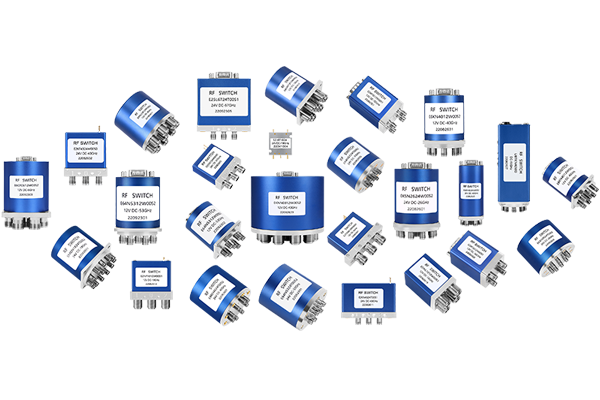
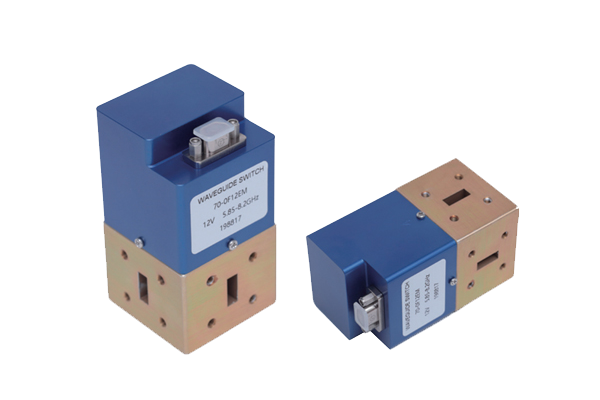
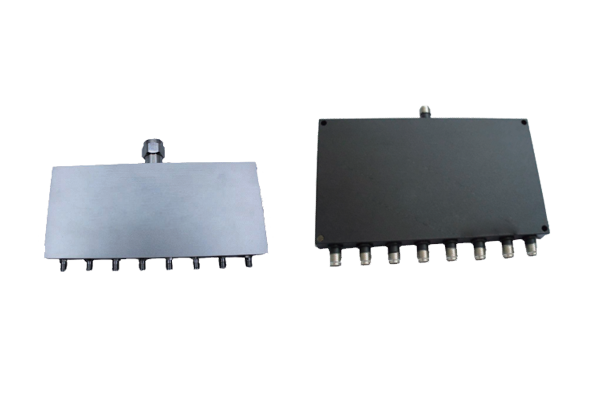
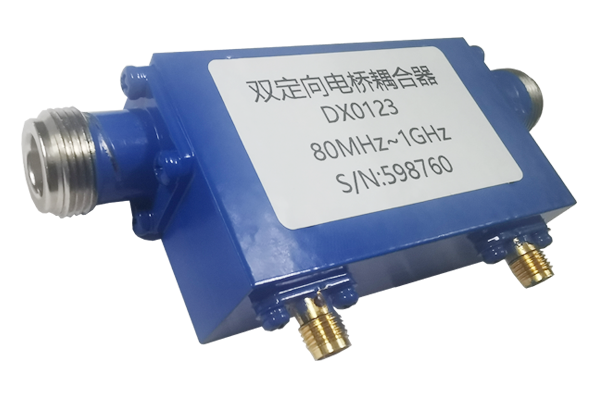
In test and measurement applications, RF switches, attenuators, directional couplers, power dividers, amplifiers, and other microwave components may be used to route, condition, monitor, and analyze spread-spectrum signals.
Frequently Asked Questions About DSSS
What does DSSS stand for?
DSSS stands for Direct Sequence Spread Spectrum. It is a spread-spectrum communication technique that uses a high-rate pseudorandom sequence to spread an information signal across a wider bandwidth.
What is the main purpose of DSSS?
The main purpose of DSSS is to improve communication robustness and resistance to certain types of interference while supporting code-based signal separation in appropriate communication systems.
What is a chip in DSSS?
A chip is one element of the high-rate spreading sequence. Chips occur at a higher rate than the original information bits and are used to expand the transmitted signal bandwidth.
Does DSSS increase transmission power?
Not necessarily. DSSS primarily spreads the signal's energy across a wider bandwidth. The increase in bandwidth does not inherently require a proportional increase in total transmitted power.
Is DSSS the same as CDMA?
No. DSSS is a spreading technique, while CDMA is a multiple-access method. CDMA systems can use direct-sequence spreading to allow multiple users to share frequency resources using different codes.
What is the difference between DSSS and FHSS?
DSSS spreads a signal using a high-rate code, whereas FHSS spreads transmission by rapidly changing the carrier frequency according to a hopping sequence.
Conclusion
Direct Sequence Spread Spectrum (DSSS) is a fundamental spread-spectrum technology in which digital information is combined with a high-rate pseudorandom sequence to expand the signal over a wider bandwidth. At the receiver, correlation with the same spreading code enables the desired signal to be despread and recovered.
The technology provides important benefits such as processing gain, interference resistance, low power spectral density, and code-based signal separation. However, these advantages come with trade-offs involving bandwidth, synchronization, receiver complexity, and spectral efficiency.
Understanding DSSS is valuable for engineers working with RF communication, wireless networks, satellite navigation, CDMA systems, spread-spectrum transmitters, and microwave test equipment.
About the Author — MeiXun Team
Chief Engineer Wang
High-tech Enterprise, Feifeng Talent
Chief Engineer Wang graduated with a master's degree in high-power microwave from the Institute of Electronics, University of Chinese Academy of Sciences.
View Full Profile- RF Switch Circuit Diagram
- RF Switch
- Ohm's Law
- dBm to Watt
- mW to dBm
- Wavelength to Frequency
- RF Connector
- SMA Connector
- RF Switch Module
- RF Coupler
- RF PIN Switch
- Microwave Coaxial Switch
- PIN Switch
- Coaxial RF Switch
- Waveguide Switch
- Microwave Switch
- Low Noise Amplifier
- PIN Diode Switch
- Coaxial Switch
- RF Microwave Switch
- SPST Switch