






Low VSWR vs High Isolation: What Matters Most in RF Switch Selection?
Selecting the right RF switch is a critical decision in microwave and wireless system design. Engineers often compare key RF switch specifications such as VSWR, insertion loss, isolation, switching speed, power handling capability, and frequency range. Among these parameters, low VSWR and high isolation are two of the most important characteristics that directly affect signal integrity and system performance.
But when choosing an RF switch, which matters more: achieving the lowest possible VSWR or maximizing isolation? The answer depends on the application, frequency range, and system requirements. This guide explains the difference between VSWR and isolation, their impact on RF performance, and how to balance these specifications when selecting an RF switch.
What Is VSWR in an RF Switch?
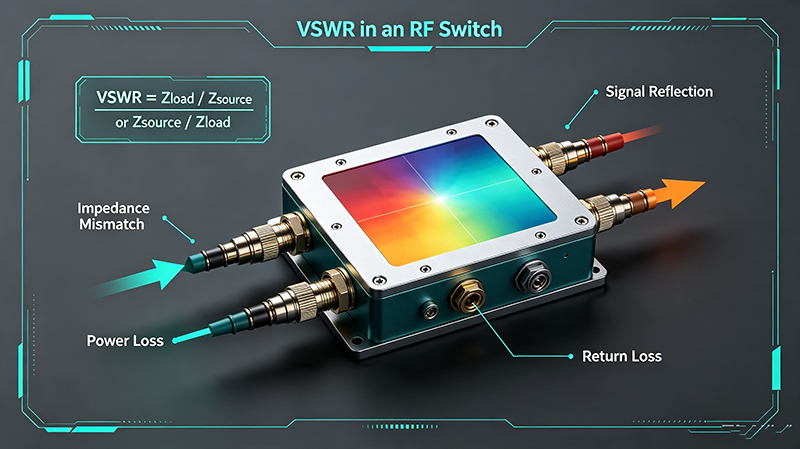
VSWR (Voltage Standing Wave Ratio) is a measurement of impedance matching between the RF switch and the transmission system. It indicates how much of the transmitted RF signal is reflected back toward the source due to impedance mismatch.
Ideally, an RF system has a perfect 50-ohm impedance match, resulting in a VSWR of 1.0:1. In practical applications, RF switches introduce small impedance variations that increase VSWR.
How Low VSWR Improves RF Performance
- Reduces reflected power and signal loss
- Improves transmitter efficiency
- Prevents damage to sensitive RF components
- Maintains better signal quality in high-frequency systems
- Improves measurement accuracy in test equipment
Low VSWR is especially important in high-frequency microwave applications where even small impedance mismatches can significantly affect signal performance.
What Is Isolation in an RF Switch?
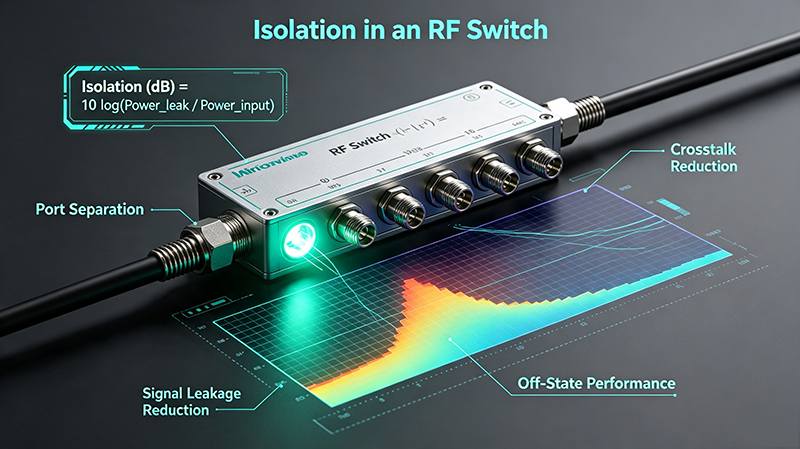
Isolation refers to the amount of signal attenuation between the selected RF path and the non-selected ports of an RF switch. It determines how effectively the switch prevents unwanted signal leakage between channels.
Higher isolation means less interference between RF paths, which is essential in systems requiring multiple channels, transmit/receive switching, or precise signal routing.
Benefits of High Isolation
- Minimizes crosstalk between RF channels
- Improves receiver sensitivity
- Protects low-noise amplifiers from unwanted signals
- Enhances measurement accuracy
- Improves system reliability in complex RF architectures
VSWR vs Isolation: Key Differences
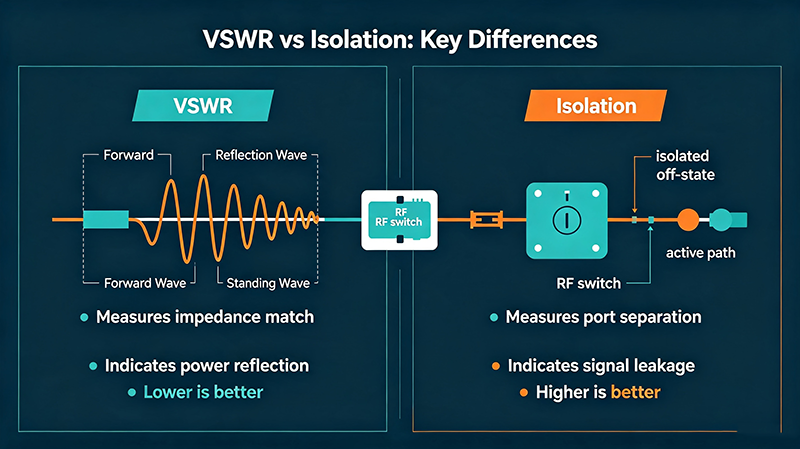
| Parameter | VSWR | Isolation |
|---|---|---|
| Definition | Measures impedance matching and signal reflection | Measures unwanted signal leakage between ports |
| Main Concern | Reflected power | Crosstalk and interference |
| Higher Performance | Lower VSWR value | Higher isolation value (dB) |
| Critical Applications | High-power transmitters, precision RF systems | Radar, communication systems, test equipment |
Why Low VSWR Matters in RF Switch Applications
In many RF systems, maintaining signal integrity is the primary goal. A high VSWR condition causes reflected signals that can reduce available power and create unwanted standing waves.
For example, in radar transmit systems, poor impedance matching can reduce transmitted power efficiency and introduce measurement errors. Similarly, in RF testing equipment, inaccurate impedance matching can affect calibration results.
Applications Requiring Low VSWR
- Radar and defense communication systems
- Satellite communication equipment
- RF test and measurement instruments
- High-power microwave systems
- 5G and wireless infrastructure
Why High Isolation Matters in RF Switch Applications
Modern RF systems often contain multiple signal paths operating at different frequencies. Without sufficient isolation, unwanted signals can leak into inactive channels and degrade overall system performance.
For example, a transmit/receive RF switch requires excellent isolation to prevent high-power transmit signals from entering and damaging sensitive receiver components.
Applications Requiring High Isolation
- Wireless communication systems
- Phased array radar systems
- Electronic warfare equipment
- Automated RF test systems
- Multi-channel measurement platforms
Which Specification Should You Prioritize?
There is no universal answer because RF switch requirements vary by application. Engineers should evaluate the complete RF system instead of focusing on a single specification.
Choose Low VSWR When:
- Your system operates at high frequencies
- Signal reflection must be minimized
- Power efficiency is a major concern
- You require accurate RF measurements
Choose High Isolation When:
- Multiple RF channels operate simultaneously
- Signal interference must be minimized
- You are protecting sensitive receiver circuits
- Your system requires clean signal routing
How Modern RF Switch Designs Balance VSWR and Isolation
Advanced RF switches are designed to achieve a balance between low VSWR and high isolation. Technologies such as electromechanical RF switches, PIN diode switches, and solid-state switches use optimized structures to improve both parameters.
Key design factors include:
- High-quality RF connectors and transmission lines
- Optimized PCB layout and impedance control
- Advanced switching mechanisms
- Precise electromagnetic simulation
- High-performance materials and manufacturing processes
RF Switch Selection Checklist
- Determine operating frequency range
- Check required VSWR specification
- Evaluate isolation requirements
- Consider insertion loss performance
- Verify power handling capability
- Select the correct switch configuration (SPST, SPDT, SP6T, SP12T, etc.)
- Consider switching speed and lifetime requirements
Conclusion: Low VSWR or High Isolation?
Both low VSWR and high isolation are essential specifications when selecting an RF switch. Low VSWR ensures efficient power transfer and minimizes signal reflection, while high isolation prevents unwanted signal interference between RF paths.
For high-frequency and precision measurement applications, low VSWR may be the priority. For multi-channel communication, radar, and receiver protection systems, high isolation is often more critical.
The best RF switch choice is one that provides the right balance between VSWR, isolation, insertion loss, power handling, and reliability based on your specific application.
About the Author — MeiXun Team
Chief Engineer Wang
High-tech Enterprise, Feifeng Talent
Chief Engineer Wang graduated with a master's degree in high-power microwave from the Institute of Electronics, University of Chinese Academy of Sciences.
View Full Profile- RF Switch Circuit Diagram
- RF Switch
- Ohm's Law
- dBm to Watt
- mW to dBm
- Wavelength to Frequency
- RF Connector
- SMA Connector
- RF Switch Module
- RF Coupler
- RF PIN Switch
- Microwave Coaxial Switch
- PIN Switch
- Coaxial RF Switch
- Waveguide Switch
- Microwave Switch
- Low Noise Amplifier
- PIN Diode Switch
- Coaxial Switch
- RF Microwave Switch
- SPST Switch