






What is an RF Filter?
An RF filter (Radio Frequency filter) is a passive or active electronic component designed to allow specific radio frequency signals to pass through while blocking unwanted frequencies. RF filters are essential building blocks in virtually every wireless communication system, from smartphones and Wi-Fi routers to satellite communications and radar systems.
In today's hyper-connected world, where 5G networks, IoT devices, and autonomous vehicles rely on clean and reliable signal transmission, RF filters play a critical role in ensuring signal integrity, reducing interference, and optimizing spectrum efficiency.
Table of Contents
1. Definition of an RF Filter
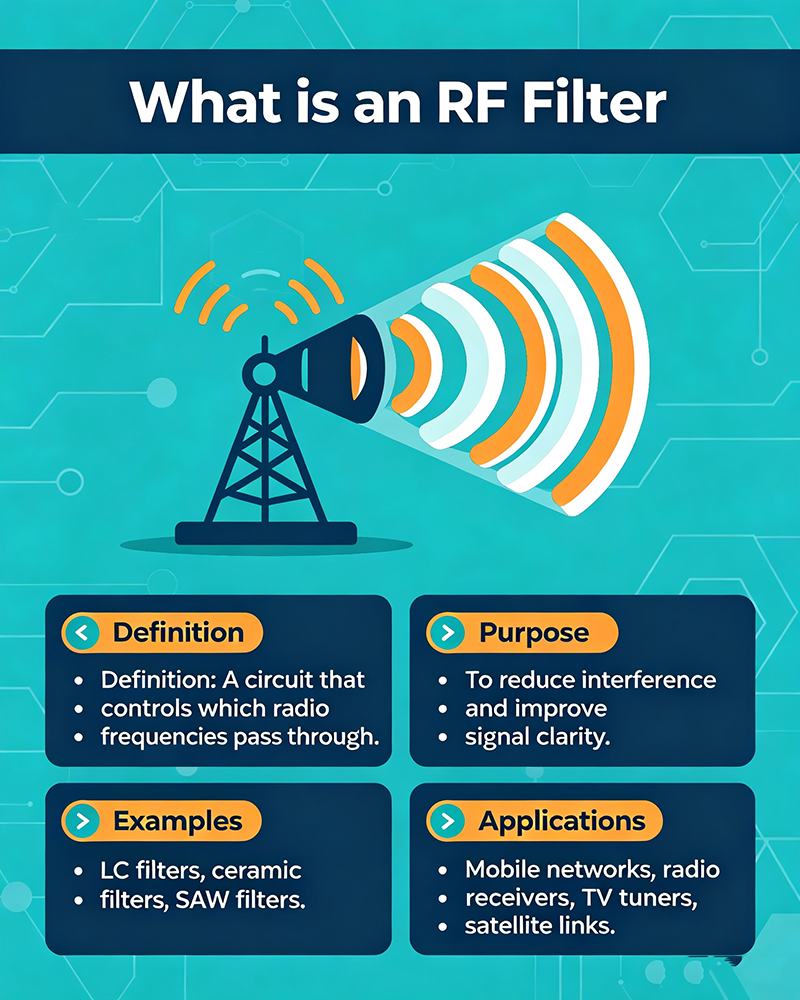
An RF filter is a two-port network that selectively transmits signals within a specific frequency range while attenuating signals outside that range. Operating typically in the frequency range from 3 kHz to 300 GHz, RF filters are used to manage the radio frequency spectrum in countless electronic devices.
The primary purpose of an RF filter is to remove noise, harmonics, and spurious signals that can degrade the performance of receivers and transmitters. Without RF filters, modern wireless systems would suffer from severe interference, reduced data rates, and unreliable connections.
Key Takeaway: RF filters are frequency-selective circuits that determine which signals reach your device, ensuring clean reception and efficient transmission across the entire radio spectrum.
2. How Does an RF Filter Work?
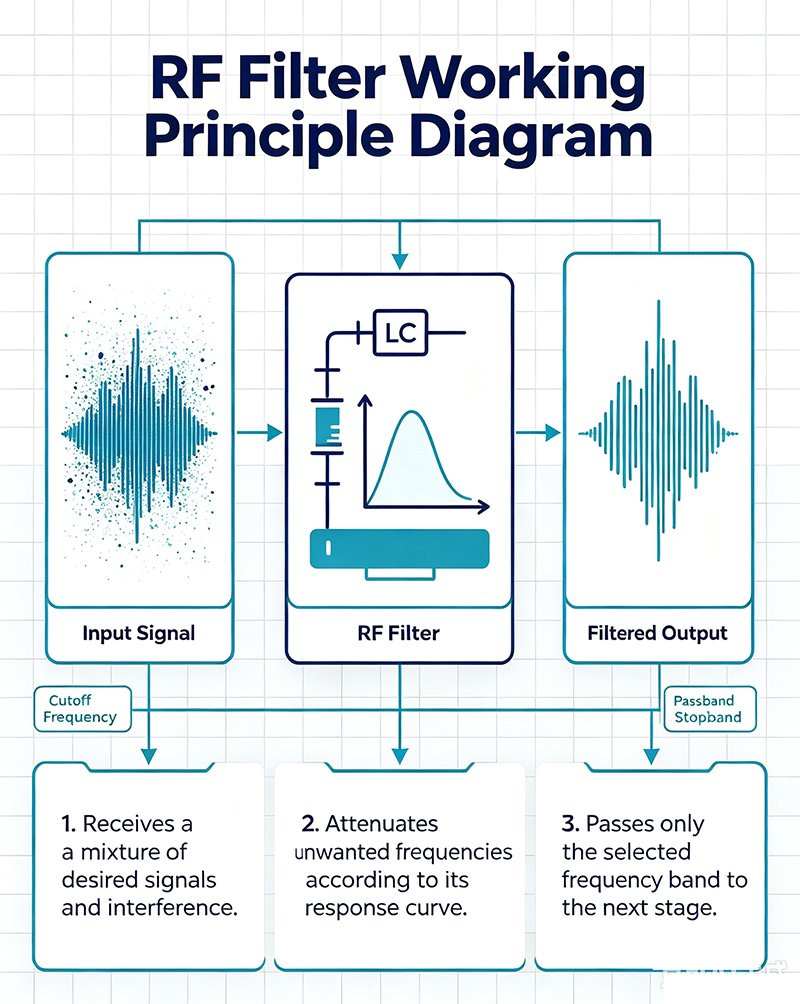
RF filters operate based on the principles of resonance and impedance matching. They are typically constructed using passive components such as inductors (L), capacitors (C), and sometimes transmission line stubs or ceramic resonators.
When an RF signal enters the filter, the LC components create a frequency-dependent impedance. Signals at the desired frequency pass through with minimal loss, while signals at unwanted frequencies are reflected or absorbed, resulting in high attenuation.
Core Operating Mechanism
- Resonance: LC circuits resonate at a specific frequency, creating either a passband or stopband.
- Impedance Mismatch: Unwanted frequencies see a high impedance mismatch, causing reflection.
- Energy Dissipation: Some filter designs absorb unwanted energy as heat.
- Insertion Loss: Desired signals experience minimal power loss through the filter.
3. Types of RF Filters
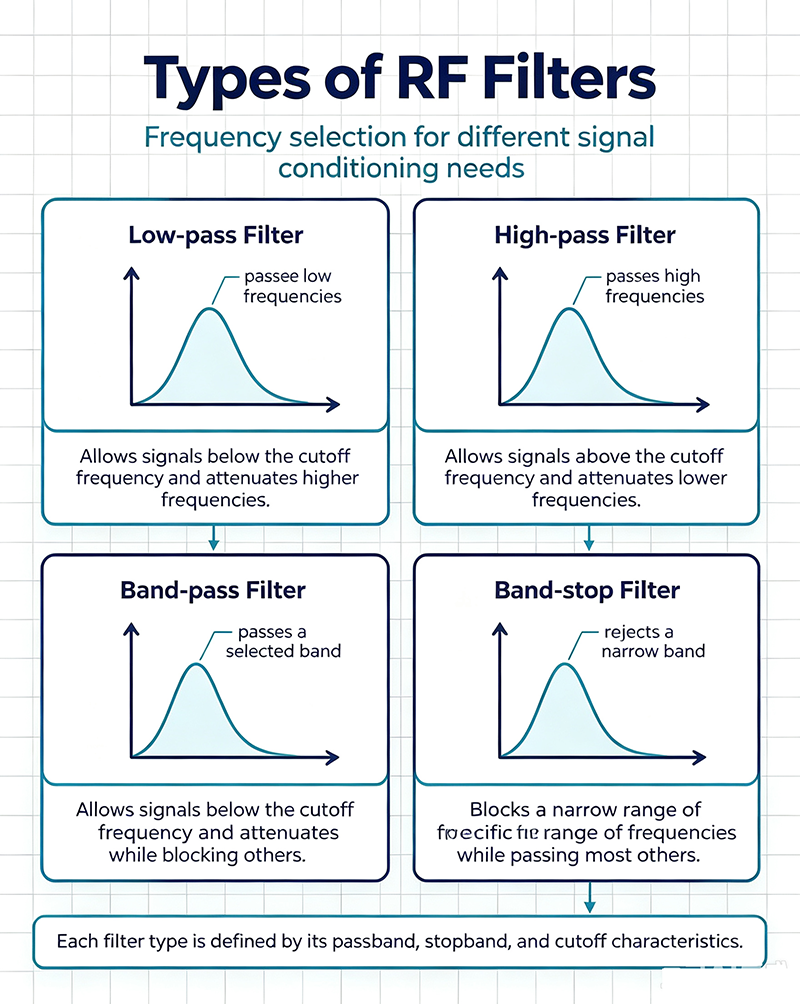
RF filters are classified based on their frequency response characteristics. The four main types are:
Low-Pass Filter (LPF)
Allows frequencies below a cutoff frequency to pass while attenuating higher frequencies. Commonly used to remove harmonics from transmitters.
High-Pass Filter (HPF)
Passes frequencies above a cutoff point and blocks lower frequencies. Used to eliminate DC offset and low-frequency noise.
Band-Pass Filter (BPF)
Selects a specific range of frequencies while rejecting both lower and higher frequencies. Essential in wireless receivers and transmitters.
Band-Stop Filter (BSF)
Also known as a notch filter, it blocks a narrow band of frequencies while passing all others. Used to eliminate specific interfering signals.
Filter Technology Categories
| Filter Type | Construction | Typical Use |
|---|---|---|
| SAW Filter | Surface Acoustic Wave | Mobile phones, RFID |
| BAW Filter | Bulk Acoustic Wave | 5G smartphones, Wi-Fi 6E |
| Cavity Filter | Metal cavity resonator | Base stations, radar |
| Ceramic Filter | Ceramic resonator | Wireless modules, IoT |
| LC Filter | Discrete inductors and capacitors | General-purpose RF circuits |
| Microstrip Filter | PCB transmission lines | Microwave circuits |
4. Key Specifications of RF Filters
When selecting an RF filter, engineers evaluate several critical specifications:
- Center Frequency: The nominal operating frequency of the filter.
- Bandwidth: The range of frequencies the filter passes.
- Insertion Loss: Signal power loss within the passband (measured in dB).
- Return Loss: Measure of impedance matching at the input and output.
- Rejection / Attenuation: The level of suppression applied to out-of-band signals.
- Q Factor: Quality factor indicating selectivity and efficiency.
- Power Handling: Maximum continuous and peak power the filter can handle.
- VSWR: Voltage Standing Wave Ratio, indicating signal reflection.
5. Applications of RF Filters
RF filters are used across virtually every industry that involves wireless communication:
Mobile Communications
Smartphones rely on dozens of RF filters for 4G, 5G, Wi-Fi, Bluetooth, and GPS operation.
Satellite Systems
Satellite transponders use highly selective filters to separate uplink and downlink signals.
Automotive Radar
ADAS systems use RF filters in 77 GHz radar modules for collision avoidance and adaptive cruise control.
IoT Devices
Low-power RF filters enable reliable connectivity in smart home sensors and wearables.
Defense & Aerospace
Military radios, electronic warfare, and avionics depend on rugged high-performance filters.
Medical Equipment
MRI machines and wireless medical devices use RF filters for signal clarity and patient safety.
6. Why RF Filters Matter in Modern Technology
As wireless devices become more compact and support multiple frequency bands simultaneously, RF filters are more critical than ever. They enable:
- Spectrum Efficiency: Maximizing the use of limited frequency allocations.
- Signal Quality: Reducing noise and improving data throughput.
- Coexistence: Allowing multiple radios to operate in close proximity without interference.
- Regulatory Compliance: Meeting strict emission and immunity standards.
- 5G and Beyond: Supporting massive MIMO, mmWave, and carrier aggregation technologies.
7. Frequently Asked Questions
What is the difference between analog and digital RF filters?
Analog RF filters use physical components (L, C, resonators) to filter signals in the RF domain. Digital filters process signals after analog-to-digital conversion, using algorithms rather than physical circuits.
What materials are used in RF filters?
RF filters can be made from ceramic, quartz, SAW/BAW substrates, PCB microstrip lines, or discrete inductors and capacitors depending on the application.
How do I choose the right RF filter?
Consider the operating frequency, bandwidth, insertion loss, rejection requirements, power handling, size constraints, and cost of the filter for your specific application.
Are RF filters the same as EMI filters?
No. EMI filters suppress electromagnetic interference across a broad range, while RF filters are precision frequency-selective devices designed for specific RF bands.
Can RF filters be tuned?
Some filters are fixed-frequency, while others (such as varactor-tuned or mechanically tunable filters) allow dynamic adjustment of the passband.
8. Conclusion
RF filters are indispensable components in modern electronics, enabling the reliable wireless communication systems we depend on every day. From smartphones and 5G base stations to satellite links and automotive radar, RF filters ensure that the right signals reach the right place at the right time.
Understanding what an RF filter is, how it works, and the different types available helps engineers, buyers, and technology enthusiasts make informed decisions when designing or selecting RF systems.
As wireless technology continues to evolve with 6G, IoT expansion, and autonomous systems, the demand for higher-performance, miniaturized RF filters will only continue to grow.
About the Author — MeiXun Team
Chief Engineer Wang
High-tech Enterprise, Feifeng Talent
Chief Engineer Wang graduated with a master's degree in high-power microwave from the Institute of Electronics, University of Chinese Academy of Sciences.
View Full Profile- RF Switch Circuit Diagram
- RF Switch
- Ohm's Law
- dBm to Watt
- mW to dBm
- Wavelength to Frequency
- RF Connector
- SMA Connector
- RF Switch Module
- RF Coupler
- RF PIN Switch
- Microwave Coaxial Switch
- PIN Switch
- Coaxial RF Switch
- Waveguide Switch
- Microwave Switch
- Low Noise Amplifier
- PIN Diode Switch
- Coaxial Switch
- RF Microwave Switch
- SPST Switch