






What is an RF Decoy?
Quick Answer
An RF decoy is a transmitting or reflecting device that produces a fake radio-frequency signature to deceive enemy radar, missiles, or communications systems. By appearing as a more attractive or realistic target than the real platform, it forces hostile weapons and operators to waste tracking, targeting, and engagement resources on a false return — keeping the genuine asset safe.
RF Decoy Definition
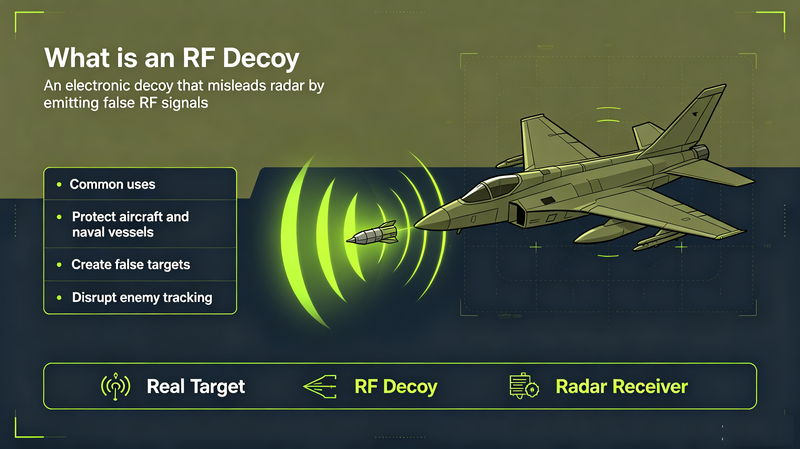
The term RF decoy combines two concepts:
- RF (Radio Frequency): any electromagnetic energy used for radar, communications, navigation, or electronic warfare, typically between 3 kHz and 300 GHz.
- Decoy: a target deliberately created to mislead an enemy's sensors, weapons, or operators.
Put together, an RF decoy is an electronic emitter, repeater, or reflector that creates a false RF return to confuse hostile detection, tracking, and weapon-guidance systems. Modern RF decoys can be airborne, naval, ground-based, or even expendable one-shot cartridges launched mid-flight.
Why Are RF Decoys Used?
Modern battlefields are saturated with radio-frequency emissions. Radars track aircraft, surface-to-air missile (SAM) systems lock onto jets, anti-ship missiles home in on radar signatures, and electronic intelligence (ELINT) platforms map every emitter they find. In this dense environment, an RF decoy serves to:
- Distract radar-guided missiles so they track the decoy instead of the real platform.
- Force premature engagement of enemy air-defense interceptors against false targets.
- Confuse ELINT collection by adding fake emitters to the electronic order of battle.
- Mask maneuvers: the real platform can turn or dive while the weapon follows the decoy.
- Degrade enemy situational awareness by cluttering their radar and communications spectrum.
How Does an RF Decoy Work?
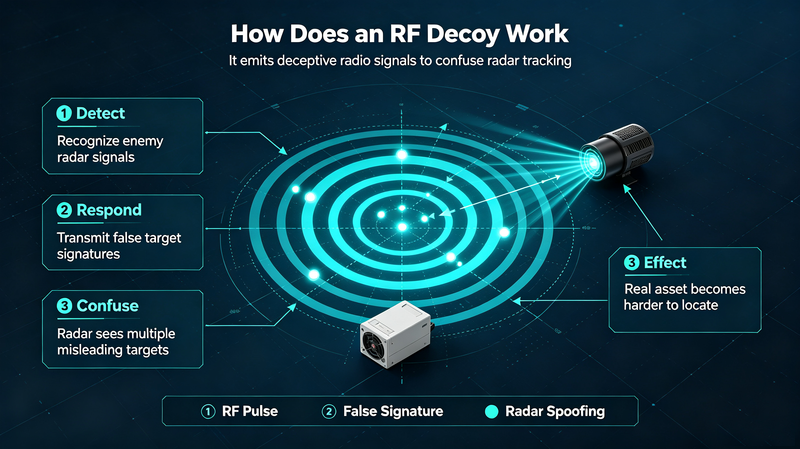
At its core, an RF decoy exploits the way radar and RF seekers measure the direction, strength, and Doppler signature of a target. It reproduces those same characteristics convincingly enough that the hostile system prefers the decoy's return over the genuine one.
Operating Principle
- The decoy's receiver detects an incoming radar pulse or communications signal.
- Onboard processing measures frequency, pulse width, repetition interval, and angle of arrival.
- An RF generator recreates the matching echo or jammer signal, often amplifying it.
- The decoy's signal is positioned so it is stronger, larger, or more attractive than the genuine platform's return.
- The hostile radar or missile locks onto the decoy, leaving the real asset untouched.
Key RF Parameters Used
| Parameter | Role in Decoy Performance |
|---|---|
| Frequency (Hz) | Must match the threat radar's operating band |
| Pulse width | Reproduces the radar's pulse shape convincingly |
| PRF (Pulse Repetition Frequency) | Mimics the scan pattern of the threat emitter |
| Power output | Higher return = higher probability of being selected as the target |
| Modulation | Matches the enemy's waveform (e.g., chirp, Barker code) |
| Doppler signature | Replicates motion characteristics the seeker expects |
Types of RF Decoys
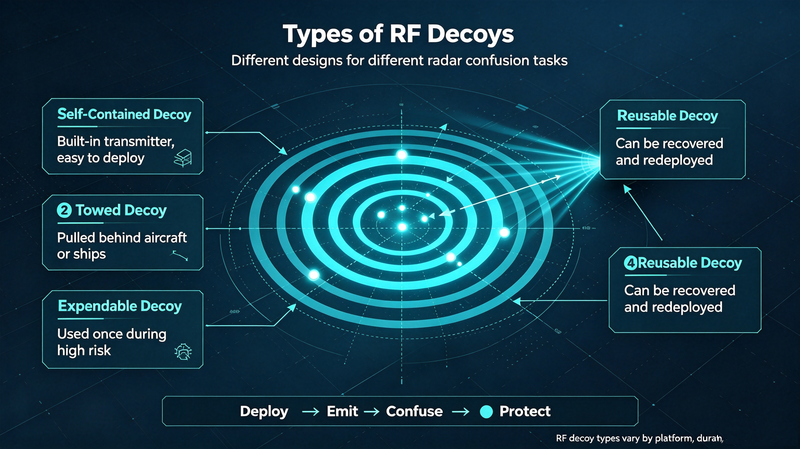
Chaff
Clouds of metallic fibers cut to half the threat wavelength that scatter radar energy to create false targets. Cheap, expendable, and effective against older radars.
Active RF Decoy
A powered transmitter that amplifies and retransmits the threat radar's pulse with high gain, producing a stronger echo than the real platform.
Towed Decoy
Streamed behind an aircraft or ship on a long cable, mimicking the parent's radar signature so the missile homes in on the decoy instead of the platform.
Expendable Decoy
Small, one-shot cartridges ejected from a launcher (e.g., ALE-47) that drift or fly autonomously to lure missiles away from the protected asset.
Drone Decoy
Unmanned aerial vehicles programmed to fly along realistic flight paths while broadcasting the same RF signature as a manned aircraft or warship.
Naval / Ground Decoy
Fixed or floating RF emitters placed on buoys, vehicles, or corner reflectors to mimic a ship radar return or radar cross-section.
RF Decoy Frequency Bands
| Band | Frequency Range | Typical Threat |
|---|---|---|
| HF / VHF | 3 – 300 MHz | Early-warning and over-the-horizon radar |
| UHF | 300 MHz – 1 GHz | Surface search and air-surveillance radar |
| L-Band | 1 – 2 GHz | Long-range air-search radar |
| S-Band | 2 – 4 GHz | Medium-range surveillance & missile guidance |
| C-Band | 4 – 8 GHz | Fire-control radar |
| X-Band | 8 – 12 GHz | Air-to-air missile seekers |
| Ku / Ka / V-Band | 12 – 75 GHz | High-precision terminal seekers |
Modern RF decoys are typically wideband or tunable, so a single device can cover multiple radar bands encountered during a mission.
Real-World Military Applications
- Fighter aircraft self-protection: Towed RF decoys like the ALE-55 defend jets against air-launched and surface-launched radar-guided missiles.
- Naval ship defense: Decoy launchers (e.g., Mk 36 SRBOC, SeaGnat) fire chaff and active RF cartridges to defeat anti-ship missiles.
- Strategic bomber penetration: Long-range aircraft dispense expendable RF decoys to break through integrated air-defense systems.
- Ground convoys & command posts: Portable RF emitters replicate vehicle or communication signatures to misdirect hostile drones and radar.
- Special operations: Low-power decoys imitate patrol radios or friendly radar to lure enemy forces into ambush zones.
RF Decoy vs. RF Jammer
Although both operate in the radio-frequency domain, they perform different jobs:
| Aspect | RF Decoy | RF Jammer |
|---|---|---|
| Goal | Create a fake target the enemy tracks | Deny or degrade the enemy's RF reception |
| Output | Coherent, target-like echo | Noise, spoofed, or saturating signal |
| Effect on radar | Pulls tracking away from real asset | Blanks the radar screen or hides the asset |
| Typical use | Defeat radar-guided missiles | Disrupt communications & radar lock |
Most modern platforms use both: decoys to lure and jammers to blind. Together they form the core of integrated electronic-countermeasure suites.
Design Challenges of RF Decoys
- Coherent signal reproduction: The decoy must match not only frequency but also phase and pulse structure of the threat radar.
- Power vs. size: Higher ERP (effective radiated power) increases survivability but limits platform endurance.
- Multi-band coverage: A single decoy must respond to several radars operating in different bands.
- Cost vs. expendability: Active decoys are expensive; one-shot chaff is cheap but less convincing.
- Survivability: Expendable decoys must operate briefly yet precisely at the right moment in the engagement.
Future of RF Decoy Technology
The next generation of RF decoys is being shaped by several converging trends:
- DRFM-based decoys: Digital Radio Frequency Memory captures, stores, and replays radar pulses with high fidelity, enabling realistic false targets.
- Cognitive EW: AI-driven decoys that learn and adapt to the threat radar's waveform in real time.
- Swarm decoys: Coordinated groups of small UAVs, each broadcasting a different RF signature to saturate enemy fire-control.
- Multi-spectrum integration: Decoys that combine RF, EO/IR, and acoustic signatures for full-spectrum deception.
- Open-architecture payloads: Modular decoy electronics that can be re-tasked in flight via software updates.
Key Takeaways
- An RF decoy is a device that emits or reflects RF energy to mislead enemy radar and missile seekers.
- It protects high-value platforms by appearing as a more attractive target than the real asset.
- RF decoys come in many forms: passive chaff, active repeaters, towed decoys, expendable cartridges, drones, and shipboard launchers.
- They operate across the entire RF spectrum from HF to millimeter-wave bands.
- Modern decoys increasingly rely on DRFM, cognitive algorithms, and swarm coordination.
Frequently Asked Questions
What does RF decoy stand for?
RF stands for **Radio Frequency**. An RF decoy is therefore a radio-frequency decoy — an electronic device that mimics the RF signature of a real platform to mislead enemy radar, missiles, or communications systems.
How is an RF decoy different from chaff?
Chaff is a passive RF decoy — strips of metal that scatter radar energy without any power source. An RF decoy in the strict sense is often active, meaning it contains a transmitter that amplifies and rebroadcasts the threat signal. Both belong to the broader family of RF decoys.
What is a towed RF decoy?
A towed RF decoy is a small jammer/decoy pod trailed behind an aircraft on a long fiber-optic cable. It reproduces the aircraft's radar return so that incoming radar-guided missiles lock onto the decoy instead of the jet, allowing the aircraft to maneuver while the missile homes on the decoy.
Can ships use RF decoys?
Yes. Warships use launchers (such as Mk 36 SRBOC or SeaGnat) to deploy RF decoy cartridges and chaff rounds. These create radar signatures similar to the ship, drawing anti-ship missiles away from the real vessel.
Are RF decoys legal for civilians?
In most countries, transmitting RF energy — even for "decoy" purposes — is regulated by spectrum authorities. Civilian possession of active RF decoys is restricted because they can interfere with aviation, maritime, and safety services. Passive decoys such as corner reflectors are generally permitted with restrictions on placement.
About the Author — MeiXun Team
Chief Engineer Wang
High-tech Enterprise, Feifeng Talent
Chief Engineer Wang graduated with a master's degree in high-power microwave from the Institute of Electronics, University of Chinese Academy of Sciences.
View Full Profile- RF Switch Circuit Diagram
- RF Switch
- Ohm's Law
- dBm to Watt
- mW to dBm
- Wavelength to Frequency
- RF Connector
- SMA Connector
- RF Switch Module
- RF Coupler
- RF PIN Switch
- Microwave Coaxial Switch
- PIN Switch
- Coaxial RF Switch
- Waveguide Switch
- Microwave Switch
- Low Noise Amplifier
- PIN Diode Switch
- Coaxial Switch
- RF Microwave Switch
- SPST Switch