






How Waveguide-Coaxial Adapters Achieve Precise Signal Separation
The Essence of Electromagnetic Mode Conversion
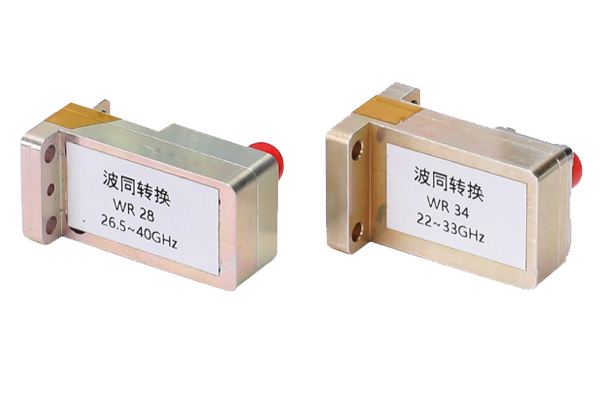
The fundamental reason for the existence of waveguide-coaxial adapters is that waveguides and coaxial transmission lines carry fundamentally different electromagnetic field modes. Rectangular waveguides transmit transverse electric or transverse magnetic modes, with electric field lines exhibiting a specific distribution; while coaxial cables only carry transverse electromagnetic modes, with a radially symmetrical electric field. The adapter uses gradient sections, steps, or probe structures to gradually transform the waveguide's field mode into the field mode required by the coaxial port. Without this mode conversion, direct connection between the two transmission lines would result in severe reflections and energy leakage. Therefore, waveguide-coaxial adapters act as an electromagnetic wave "translator," ensuring complete power transmission when signals cross different media.
- Converts TE/TM waveguide modes to coaxial TEM mode
- Gradient sections, steps or probe structures reshape field distribution
- Prevents severe reflections & energy leakage
- Acts as electromagnetic wave "translator" across media
The Physical Process of Probe Coupling
The most common implementation involves inserting a metal probe into the waveguide cavity, which simultaneously extends the inner conductor of the coaxial cable. The probe is placed at the center of the wide wall of the waveguide where the electric field is strongest. When a forward traveling wave passes through, the alternating electric field induces a high-frequency current on the probe surface, which is output along the inner conductor of the coaxial cable. In reverse operation, the coaxial signal radiates from the probe into the waveguide, exciting the corresponding transmission mode. The probe's length, diameter, and insertion depth are precisely designed to achieve impedance matching. These probe-type Waveguide-Coaxial Adapters are simple in structure, technologically mature, and cover a wide range from microwaves to millimeter waves.
- Metal probe extends coaxial inner conductor into waveguide cavity
- Positioned at wide wall center (maximum electric field)
- Alternating E-field induces HF current on probe surface
- Bi-directional: coaxial signal radiates corresponding mode
Impedance Matching & Wideband Design
The characteristic impedance of a waveguide varies with frequency and is usually not equal to the fixed impedance of the coaxial cable. To ensure low-reflection transmission, Waveguide-Coaxial Adapters incorporate multiple impedance transformation sections: for example, creating a ridge waveguide gradient region on the waveguide side or using stepped dielectric filling. Some designs also add a compensation disk or tuning screw at the probe root. Optimizing the geometry of these structures through electromagnetic simulation allows for good voltage standing wave ratio (VSWR) control across the entire waveguide bandwidth. Good impedance matching makes the adapter a transparent channel, allowing energy to flow almost without backflow, avoiding multiple reflections that interfere with system measurements.
- Compensates frequency-varying waveguide impedance vs. fixed coaxial Z
- Ridge waveguide gradients, stepped dielectric filling
- Compensation disk or tuning screw at probe root
- VSWR optimized across full waveguide bandwidth
Stray Modes & Leakage Suppression
Imperfect adapters can excite higher-order modes or generate radiated leakage, compromising signal purity. Waveguide-Coaxial Adapters suppress asymmetric modes through strict structural symmetry, while integrating absorber loads or short-circuit pistons at the waveguide ends to capture reverse leakage energy. Conductive overlap or flange gears between the coaxial outer conductor and the waveguide wall eliminate gap radiation. Furthermore, a cutoff waveguide section can be incorporated within the adapter to rapidly attenuate modes below the cutoff frequency. Through these suppression measures, Waveguide-Coaxial Adapters ensure a clean main signal and stable operation in critical systems such as radar, satellite communications, and test and measurement.
- Strict structural symmetry suppresses asymmetric modes
- Absorber loads / short-circuit pistons trap reverse leakage
- Conductive overlap eliminates gap radiation
- Cutoff section attenuates below-cutoff modes